Post-Market Monitoring Obligations for Deployed Enterprise AI Systems
Enterprises must monitor deployed AI continuously under the EU AI Act.

Post-market monitoring for deployed enterprise AI is a continuous operational discipline. It links drift detection, incident escalation, and audit-ready evidence for as long as the system is in use. Closing the accountability gap requires those capabilities to be working from the first deployment, with responsibility assigned before production use begins.
Why most deployed enterprise AI systems have an accountability gap
A deployed AI system is not necessarily a governed one. Controlled testing establishes performance under the conditions used for validation, but production changes those conditions. Inputs shift, output distributions change, and the operational context moves away from the one the model was tested against. A good model can therefore degrade quietly until someone outside the organization documents the harm. Deployment begins the ongoing governance obligation.
Mumtaz et al. (2026) coded real-world AI incidents from 2020–2026 against post-deployment provisions and found that most, by a large margin, had no evidence of post-market monitoring. That finding concerns documented evidence and leaves open whether affected organizations had monitoring in place. Nevertheless, it exposes the gap between pre-market assessment and demonstrable oversight in use. The EU AI Act makes that distinction enforceable. Article 72 requires providers of high-risk systems to actively and systematically collect, document, and analyze performance data for as long as the system is in use.
Unread logs do not meet that standard. Annex IV requires the monitoring plan to form part of the technical documentation before a high-risk system enters the market. Article 73 also sets duties and deadlines for serious-incident reporting, and failure to comply has financial costs. These duties also have extraterritorial reach, including providers outside the EU whose systems’ outputs are used within it. The supplied regulatory material is unclear on deferred dates, so this article treats the enforcement timetable as unsettled.
Annex III includes recruitment, credit scoring, critical infrastructure, education, law enforcement, biometric identification, migration, asylum and border control, and the administration of justice and democratic processes. Annex I covers products that are regulated, including medical devices, machinery, and aviation. These categories mean that high-risk AI governance matters in everyday enterprise work, though how a system is classified depends on what it is and what it is used for.
The provider–deployer split and where enterprise accountability actually falls
Article 26 requires deployers to tell providers of serious incidents, help with monitoring, and report malfunctions to market surveillance authorities. Responsibility is therefore divided between provider and deployer. An enterprise that assumes its supplier handles everything can leave a gap between the provider’s system-level monitoring and the deployer’s knowledge of actual use.
The distinction becomes more consequential when an enterprise develops its own system. A company that builds and deploys high-risk AI for internal use acts as both provider and deployer, assuming the Article 72 and Article 73 obligations. Substantial modification can also change the enterprise’s role. A deployer that substantially modifies an existing high-risk system, or integrates it into a new context that changes its purpose, may become the provider of a new system. That shift brings duties for technical documentation and monitoring alongside responsibility for running the software.
An auto dealer group using agents within an operational workflow can have an implementation partner involved in delivery while the enterprise controls the context of use. The contractual division of work does not, by itself, resolve the regulatory roles. Where a deployment is high-risk, responsibility turns on who develops, places, uses, or substantially modifies the system. Legal and healthcare deployments have the same boundary problem, though the signals they need to monitor differ.
This boundary must be settled before an incident. A defined AI incident response procedure identifies what counts as reportable and who owns regulatory notification. It is separate from general IT incident response because AI accountability cannot be reduced to responsibility for infrastructure. Without that split of duties, both parties may have information that matters while neither has the duty to act on it.
What a compliant post-market monitoring system actually tracks in production
Article 72’s requirement for active, systematic collection translates into continuous signals, a defined review cadence, and structured analysis. Quarterly review alone is not enough. Nor is a ticketing system that waits for users to notice degraded performance. Core measures such as accuracy, precision, recall, F1 score, or output-appropriate equivalents need a fixed reference in the Annex IV technical file. Comparing production results with that baseline makes deterioration measurable.
Prediction drift adds a different view of performance. Changes in output distributions can reveal that the system is behaving differently as inputs move away from the training distribution. Rising prediction entropy or changing output category frequencies can signal a need for retraining or model adjustment. These signals require interpretation against the validated use case. Without that comparison, an enterprise can retain a launch-time performance claim that no longer describes production behavior.
Human oversight supplies another source of evidence. Article 14 requires oversight mechanisms for high-risk systems, and a sustained increase in operator overrides is a leading indicator of degradation that must trigger investigation. Aggregate performance measures also need to be complemented by bias and fairness indicators where systems process personal data across population groups. Stable overall accuracy can obscure declining reliability for groups covered by anti-discrimination law. Monitoring therefore has to detect differential degradation alongside changes in the system-wide average.
Healthcare makes the limits of a single drift measure particularly clear. Data drift concerns gradual changes in input characteristics, while phenotype drift concerns changes in disease morphology that affect what the model was trained to detect. Concept drift occurs when clinical best practices and diagnostic standards change and the outputs no longer reflect them. These are distinct monitoring targets. Treating them as interchangeable risks overlooking whether the inputs, the clinical phenomenon, or the standard for a correct answer has changed.
Multi-agent pipelines need monitoring that reaches beyond each model. Message loss, conflicting instructions, and handoff timeouts can degrade joint behavior even when each agent performs within specification. Article 72 requires analysis of interactions with other AI systems where relevant, so per-agent evaluation alone is insufficient. Generative AI also requires attention to PII exposure and hallucinations, as well as drift, bias, and accuracy degradation. Automated monitoring addresses these signals before reliance on user complaints turns an internal performance problem into an externally documented incident.
Incident escalation: what must happen when monitoring surfaces a problem
Detection creates a decision and response obligation. A monitoring system is only as effective as the escalation procedure that receives its findings, assesses severity, and assigns action. The same study found much higher compliance among incidents detected through internal monitoring than among those detected externally. That link supports the need to be able to monitor systems, but it does not prove that detection alone leads to compliance. The operative connection is between finding a problem and handling it through a defined process.
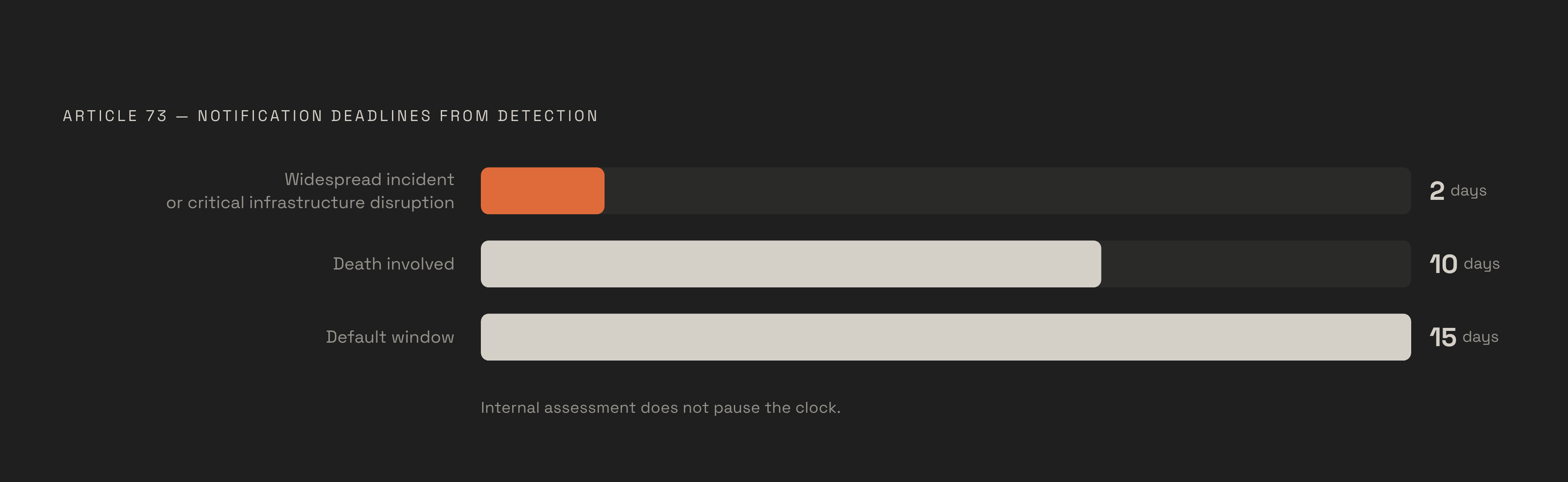
Article 73 makes that connection time-sensitive. The default reporting window is 15 days, reduced to two days for widespread incidents or serious and irreversible disruption of critical infrastructure, and ten days when a death is involved. These windows begin from detection. An internal assessment process cannot be treated as a pause in the reporting clock. Severity classification must therefore link directly to the deadline for reporting the incident.
The AI incident procedure gives that connection an owner. It specifies what constitutes a reportable AI incident, distinguishes that category from a general outage or data breach, and names responsibility for notifying national market surveillance authorities. It also maps internal severity assessments to the Article 73 categories. Those definitions allow a monitoring alert to enter an established response path rather than initiate a debate about jurisdiction inside the organization.
A procedure on paper is still incomplete. The path from detection through severity assessment to notification must be tested so that responsibility does not depend on improvisation when a deadline is running. The response process must also preserve evidence of the finding and its handling, linking escalation to the record a regulator can inspect.
Generating audit-ready evidence as a continuous output of the monitoring system
Audit readiness follows from how monitoring and response are built. Regulators expect evidence of continuous compliance to be accessible on request, rather than assembled retrospectively from logs designed for another purpose. A collection of events without structured analysis does not demonstrate that performance was reviewed or that a detected problem reached the responsible party.
The technical file must change with the system. Annex IV places the monitoring plan in pre-market documentation, but monitoring-driven updates must also be reflected throughout the operational lifetime. Article 10 also requires evidence of data governance. Changes in input distribution or data quality are themselves compliance signals that must be documented and fed back into risk management.
Structured audit trails need to capture what the agent knew at the time of a decision, allowing a reviewer to reconstruct the decision path and assess whether it remained within approved business definitions and access rules. An output alone cannot establish that context. Evaluation probes embedded within agentic workflows support real-time auditability by generating evidence at the point of action.
These records belong to one lifecycle evidence chain. Design decisions set the approved conditions, deployment puts them into use, and post-market monitoring records whether performance and behavior stay within them. Escalation records then show how departures were handled. A static policy document cannot substitute for that chain, however thorough its wording. Evidence generation is therefore part of running the system.
What production readiness means when post-market monitoring obligations are in scope from day one
Production readiness requires monitoring infrastructure, escalation procedures, and evidence generation to be live when the system enters production. Where post-market obligations apply, retroactive installation leaves an interval without the required oversight. Readiness must describe the whole operating system around the model, including how degradation is detected, how intervention occurs, and what can be demonstrated afterward.
The nine dimensions of readiness are simultaneous requirements. They include reliability, evaluation in continuous integration, observability, guardrails and security, cost controls, human oversight, error handling, versioning and rollback, and compliance. Post-market monitoring touches most of them because a detected problem needs both an operational response and an evidentiary record. Runtime governance beneath the model layer adds deterministic policy enforcement before undesired actions reach the wire. That pre-action control is also a source of the evidence needed by auditors and incident investigators.
The practical implication is to validate these capabilities during rollout. Staged gates allow live traffic to expand progressively while monitoring is tested under real conditions before full exposure. Rollback drills test whether an alert can lead to an executable response. A dedicated owner for the post-market monitoring program gives these activities a clear point of accountability. Ownership is an operating prerequisite.
When an enterprise commissions an agent for its own operations, it often becomes both provider and deployer, making the division of duties with its implementation partner especially important. Eigenomic, an enterprise AI agent builder that owns complete workflows end to end, is one implementation option whose approach includes observability, audit trails, and human escalation paths from the initial engagement. Such an engagement makes it essential to settle monitoring and incident-reporting duties before deployment, rather than assume the partner relationship assigns them.
The first deployment decision must therefore include an operating commitment. Regulatory scope determines the legal duties, but it does not remove the operational need to detect and handle degradation. The accountability gap is a design choice, and the deployment plan can make a different one.
Notes
- Post-Deployment Accountability in AI Governance: A Cross-Regulatory Empirical Analysis of AI Incidents
Supplied the finding that most coded real-world AI incidents lacked evidence of post-market monitoring, and that internally detected incidents showed higher compliance.
- Building Production-Ready AI Agents in 2026
Contributed the nine dimensions of production readiness, staged rollout gates, rollback drills, and runtime governance beneath the model layer.
Every new piece from Hallucination Report, as it's published.
Follow