Human Oversight Requirements Under EU AI Act for Automated Decisions
Article 14 turns oversight into a design duty, not a staffing task.
Human oversight under the EU AI Act is a set of engineering and organizational obligations for high-risk automated decision systems. Article 14 defines five capabilities that people must be able to exercise during use. Compliance therefore depends on the system’s interfaces, controls and architecture, together with the deployer’s ability to put those controls into practice.
What Article 14 actually requires and why it is an engineering problem, not a staffing one
A named person on an organization chart does not establish effective human oversight. Article 14 requires high-risk AI systems to be designed and developed, including with appropriate human-machine interface tools, so that natural persons can oversee them effectively throughout use. The operative word is “designed,” not merely “assigned.” The obligation concerns what the system enables a person to understand and do.
The Act’s structure reinforces that reading. Article 14 sits in Chapter III, Section 2, with the data governance, logging and other requirements in Articles 9–15. It is part of a technical specification. Oversight provides a backstop when other safeguards fail to contain risk. A human who cannot detect a problem or intervene cannot perform that role, regardless of how clearly a policy assigns responsibility.
The five capabilities Article 14(4) mandates and what each one implies for the build
Article 14(4)(a) requires the overseer to understand the system’s capacities and limitations and monitor its operation for anomalies, dysfunctions and unexpected performance. Developer documentation alone is not enough. Limitations must be written at the overseer’s level of expertise, while live anomaly signals must appear in the operator interface. Those documents and signals show that the overseer can monitor the system in practice, including what would otherwise stay in backend logs.
Article 14(4)(b) requires awareness of the tendency to rely or over-rely on AI output. An interface that presents a recommendation as settled fact undermines that capability. Confidence indications and friction on consequential actions are concrete design responses. Article 14(4)(c) also requires overseers to interpret output correctly with the tools and methods available to them. Evidence here includes explanations pitched at the overseer’s expertise and usability testing with the actual oversight population.
Article 14(4)(d) requires the ability not to use the system or to disregard, override or reverse its output. That control must be reachable when the decision occurs. A procedure buried in a manual or dependent on another team creates an operational barrier. Overrides must also be recorded as part of system-operation logging under Article 12, although the Act’s explicit logging cross-reference for two-person verification does not specifically extend to this override capability.
Article 14(4)(e) requires intervention or interruption through a stop button or similar procedure that halts the system safely. Stopping execution is not the same as reaching safety. Evidence must include a defined safe state and a tested path into it. The reachable override and safe-state halt are often under-built because both need to be engineered before deployment.
How responsibility is split between providers and deployers, and where each party most often fails
Providers must build oversight measures into the system or identify measures for deployers to implement. Deployers must make those measures work in their setting. Article 26(2) requires them to assign natural persons with the necessary competence, training and authority, and provide the necessary support. Competence means domain expertise sufficient to evaluate output, while training must address the particular system and connect to the Article 4 AI literacy duty. Support means having time, information and tooling for oversight without having to squeeze it between other tasks.
A vendor contract does not transfer this regulatory responsibility. The deployer remains responsible for its own obligations. For some deployers, Article 27 also requires a fundamental rights impact assessment before deployment that describes oversight measures, internal governance and complaint mechanisms. These requirements can connect AI governance to existing privacy governance infrastructure.
The sharpest operational failure is often the authority gap. An overseer must be able to overrule the system without seeking permission. If disagreement requires managerial approval or more justification than agreement, the organization discourages independent judgment. The system then becomes the decision-maker in practice, while the human’s involvement supplies only a record of nominal oversight.
Why automation bias is a design constraint, not a training problem
An operator who approves every recommendation within seconds may satisfy a superficial requirement for human involvement. That does not establish independent judgment. Article 14 addresses this rubber-stamp pattern by requiring systems to be designed for oversight, including measures that help people stay aware of automation bias. Training alone cannot repair an interface that presents uncertain output as authoritative or makes disagreement harder than acceptance.
The provider and deployer therefore have interdependent responsibilities. The provider supplies confidence signals, consequential-action friction, usable explanations and recorded override channels without escalation. The deployer supplies the operating conditions in which those tools can work. Having many decisions to make and little time to make them creates particular pressure because accepting output as a matter of course takes less effort than checking it. Neither party can resolve that pressure alone.
Practical assessment must examine behavior. Individual decisions must be available for review rather than hidden behind aggregate dashboard metrics. Overseers must be able to act without waiting for a manager to sign off. An override rate approaching zero is a reason to investigate whether judgment is being exercised.
Three oversight models the Act recognises and when each is appropriate
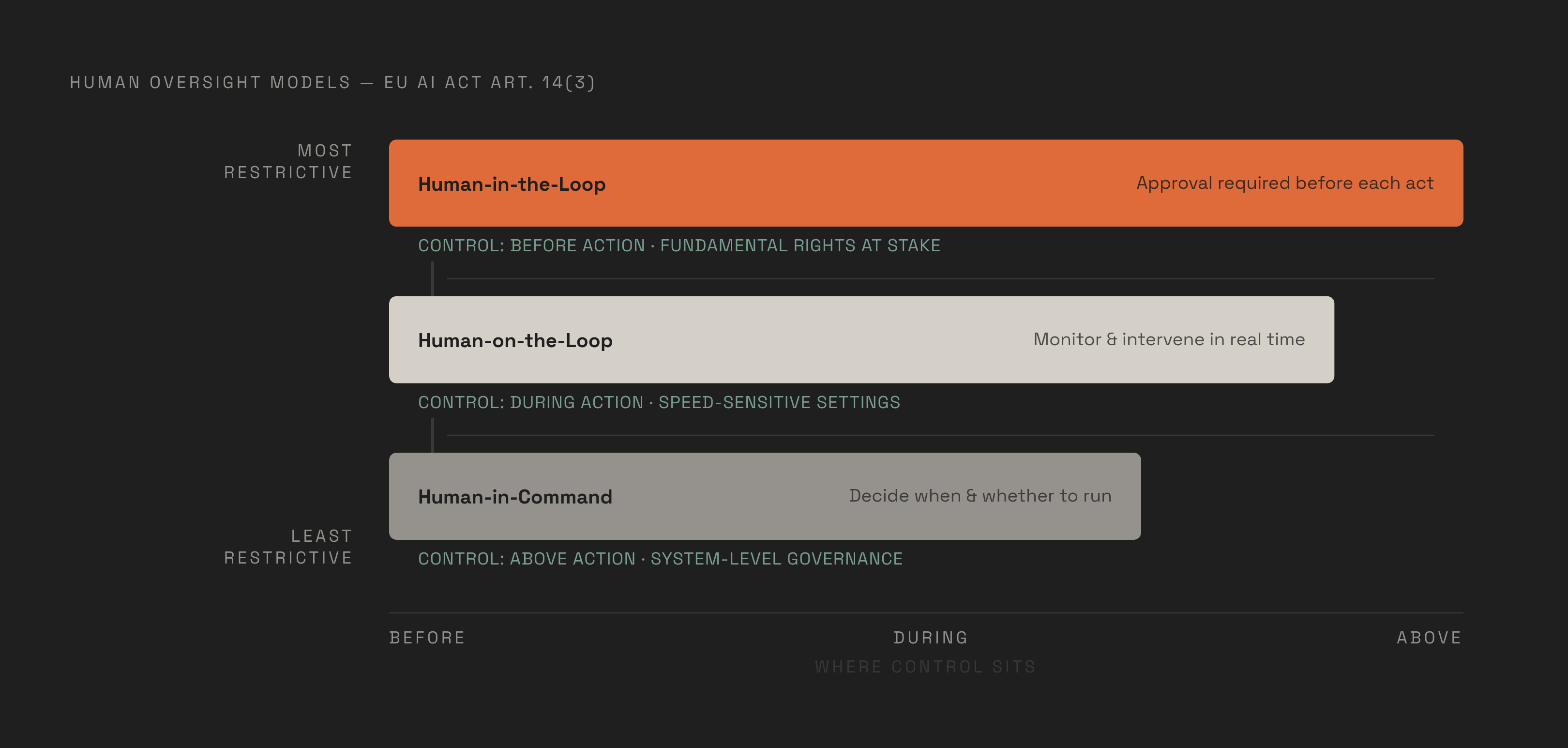
Article 14(3) requires oversight measures proportionate to risk. Regulatory guidance recognizes three practical models, rather than the statutory provision itself enumerating them. Providers must build an appropriate approach into the design and justify their choice in technical documentation. The choice determines where human control enters the workflow.
Human-in-the-loop requires a human decision at each step before the system acts. It is the most restrictive model. It is appropriate where latency is acceptable and an unchecked decision poses the greatest stakes, and is typically required where decisions directly affect fundamental rights. Human-on-the-loop instead permits autonomous action while a person monitors in real time and can intervene or halt operation. It suits settings where speed matters but a person must be ready to use their judgment at all times.
Human-in-command places control at the level of deciding when and how the system is used, overriding output and stopping it entirely. This model suits outputs that come less often and have less at stake, with governance providing control at the system level. Deployers must still validate the provider’s choice against actual working conditions. A dashboard checked daily cannot support a model that depends on real-time monitoring.
Some uses remove that discretion. Article 14(5) imposes a four-eyes rule for remote biometric identification under Annex III point 1(a). No action or decision may follow unless at least two natural persons with the necessary competence, training and authority have separately verified and confirmed it. Model selection cannot replace that structural requirement.
Where agentic AI systems create the sharpest Article 14 tension
Autonomous agents are built to work without a person watching all the time, while Article 14 requires oversight that works while they are in use. Agents require architecture that preserves human control across multi-step workflows. A system prompt saying “ask before acting” is not an external engineering constraint, and activity logs reviewed after consequential actions cannot substitute for intervention.
Approval gates must block actions above defined thresholds until a human confirms that they can go ahead. Hard scope boundaries must limit what the agent can do without approval. Automatic alerts must flag risk or scope breaches before the work is done where possible, and dashboards must show each action as well as aggregate performance. The stop mechanism must also lead into a defined, tested safe state.
The evidence layer must keep a full trace of the workflow. Traditional input-output records do not capture session metadata, user context, reasoning steps, tool calls and results, before-and-after states, and human overrides. Article 19 requires logs to be kept for at least six months, so how to keep them is a data architecture decision for agents that take many steps in each session. Continuous human presence at every action is not the objective. The requirement is an architecture in which meaningful intervention remains possible.
What compliance looks like in practice across healthcare, legal, and automotive contexts
In healthcare, Article 26(2) competence maps to clinical expertise. A clinician who defers to a diagnostic tool may miss conditions the system was not trained to detect, and high-volume clinical work increases pressure to accept recommendations routinely. Hospitals are advised to establish multidisciplinary governance committees that embed risk management, technical documentation and oversight within existing clinical governance and quality assurance.
In legal services, oversight must protect the judgment of the lawyer-of-record and attorney-client privilege, keep matters separate and ensure that AI use is disclosed. The lawyer must retain authority over the assessment. Decisions affecting individuals must also be explainable to the affected person and to regulators. That requires records of reasoning steps, retrieval sources, tool calls and factor weights. The override record can consequently serve both as evidence of human control and as part of the explanation for a decision.
In automotive settings, safety-component AI is likely to count as high-risk, so duties for conformity assessment, oversight and auditability apply alongside the type-approval requirements already in place. Safe-state design becomes especially demanding in this context. Halting execution in a vehicle safety system must reach a state distinct from both normal operation and system failure. Product-embedded systems, including vehicles and machinery, also face a product-conformity assessment overlay. Their Chapter III applicability date is 2 August 2028.
How deployers should structure an oversight compliance check before deployment
Deployers should make sure oversight is ready before they put a system into use. Design-stage gaps are less expensive to address than live-system failures. The EDPS checklist provides a framework covering governance, competent users, escalation, logs, performance indicators, appeals, root-cause analysis and authority to override or suspend output. Within that framework, the assessment should test the five statutory capabilities in sequence.
For 14(4)(a), reviewers should check that overseers have the expertise to understand the limitation documents and that anomaly signals appear in the operating interface. For 14(4)(b), they should check confidence signals, consequential-action friction and records of training on automation bias in the system being used. Under 14(4)(c), explanation tools must be tested with the overseers who will use them. Assumed usability is not sufficient evidence of readiness. For 14(4)(d), the check should establish whether overrides are reachable without escalation, recorded automatically and reviewed through override-rate monitoring. For 14(4)(e), it should check the defined safe state and the results of halt-path tests.
The supporting record should name each system’s oversight model, explain why it was chosen and list the people assigned to it, who attended training and the override logs. Where Article 27 applies, the fundamental rights impact assessment must describe oversight and internal governance, and the DPIA processes already in place offer a natural way to bring this work together. The cross-cutting test is whether the system can be monitored, supported and stopped safely at scale. A sound provider-side design cannot compensate for an operating environment that fails that test. After deployment, agreement rates should still be checked so that, when people accept almost every output, this prompts a check of whether oversight still works.
The enforcement timeline and what organizations building or deploying high-risk AI systems must act on now

The AI Act Omnibus political agreement of 7 May 2026 shifted the high-risk compliance timetable. Annex III systems must comply by 2 December 2027, while Annex I product-embedded systems must comply by 2 August 2028. Those dates do not defer every obligation. The prohibitions in Article 5 have applied since 2 February 2025, and the transparency obligations in Article 50 have applied since 2 August 2026. For systems already deploying under the earlier applicability window, oversight compliance is already an active obligation.
Violations of high-risk system obligations expose organizations to fines of up to 3% of global annual turnover. Organizations working toward December 2027 must decide now how to design oversight because approval gates, reachable overrides and safe-state transitions shape how the system works. They are not controls that can reliably be added in the final quarter.
An AI Operations Audit focused on oversight is the structured starting point for organizations without a systematic view of exposure. It should identify high-risk systems, assess the justification for each oversight model and test the five capabilities. It must also check that deployers have the competence, training, authority and support they need. Continuous measurement belongs in that assessment too. The audit should establish whether value and failure can be measured over time, so that growing operational spend is matched by evidence that oversight controls work.
Notes
- EU AI Act High-Risk Deadline: Enterprise Readiness Gap
Supported the compliance deadline discussion and the fine exposure for high-risk obligations.
- EU AI Act shines light on human oversight needs
Informed the discussion of Article 14 oversight needs and how oversight depends on system design and deployer capability.
- U.S. Companies Face EU AI Act's Possible August 2026 Compliance Deadline
Provided context on the shifting August 2026 deadline and the timeline for high-risk compliance.
Every new piece from Hallucination Report, as it's published.
Follow