EU AI Act Conformity Assessment Process for Enterprise Deployers
Deployers must verify provider evidence and run their own oversight.
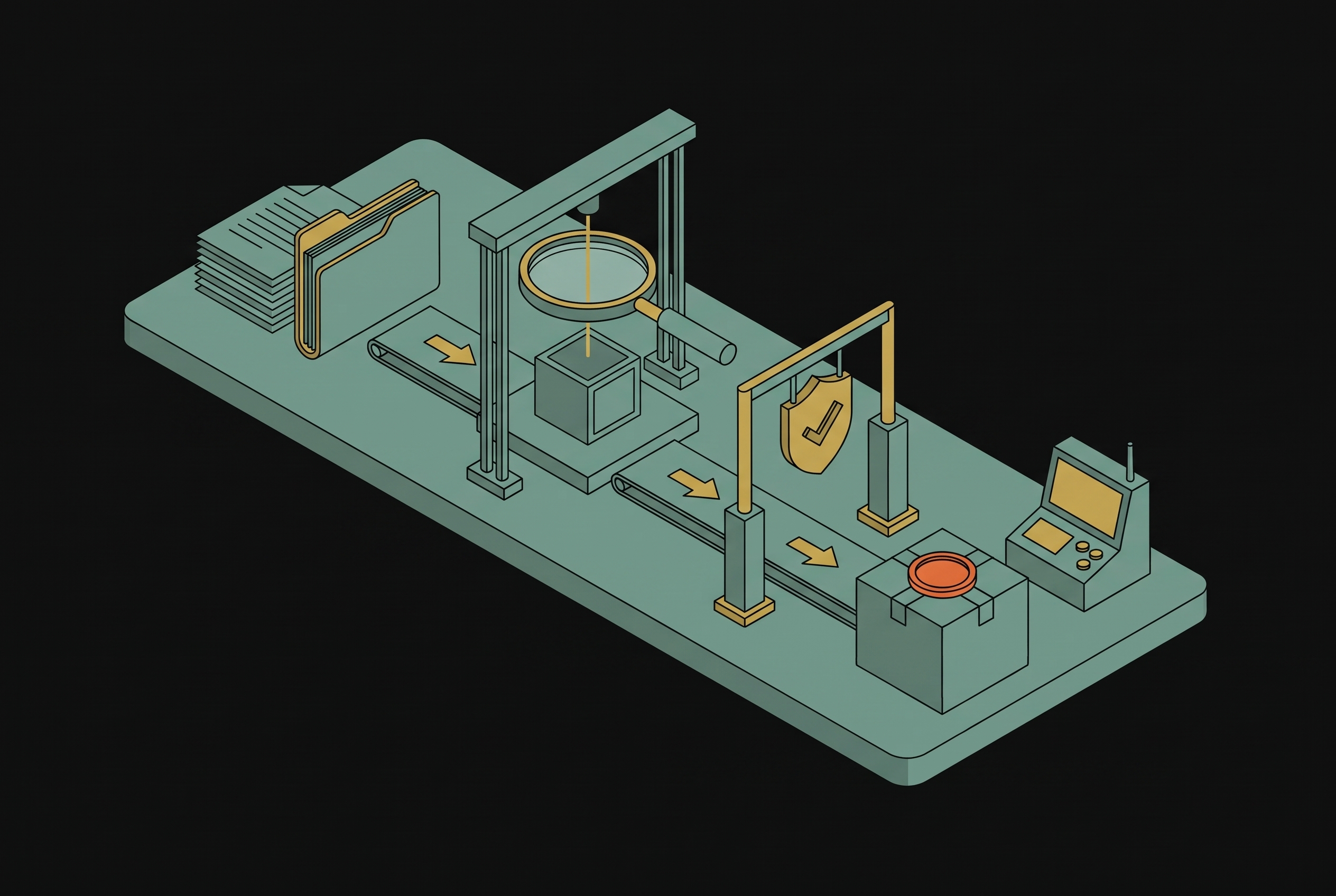
Enterprise deployers must verify the provider’s evidence and operate their own oversight, monitoring, logging, and rights-assessment programme. The practical foundation of compliance is knowing where the provider’s responsibility ends, where the deployer’s begins, and which changes can make the enterprise responsible for both.
How the EU AI Act splits compliance responsibility between providers and deployers
Article 3(4) defines deployers broadly as people or organisations using an AI system under their authority, except for personal, non-professional activity. A hospital using a third-party diagnostic tool, a bank integrating a credit-scoring model, and a recruitment platform ranking CVs can all occupy this role. Ownership is not the deciding factor here. The relevant distinction is between providing the system and using it under the organisation’s authority.
Providers must carry out the conformity assessment for high-risk systems. Before bringing those systems to market, they must complete the applicable assessment, register in the EU database, implement a quality management system, and activate post-market monitoring. Deployers have a separate responsibility for how the system is used. This division creates two distinct areas of accountability, with the enterprise’s role determining which requirements apply.
What conformity assessment actually covers, and why deployers need to understand it
Article 43 provides two assessment tracks. Internal self-assessment under Annex VI is the default for most Annex III categories, including HR systems, credit scoring, educational tools, and administration of justice. No notified body participates in that track. The absence of an external assessor therefore does not, by itself, indicate that a provider has failed to complete the required process.
The third-party track under Annex VII involves a notified body and applies to specified biometric identification systems. AI built into products regulated under Annex I takes a different route when sectoral legislation requires third-party assessment. For those products, the AI Act assessment is folded into the sectoral procedure, which replaces direct application of Annex VII. This distinction is important when reviewing evidence for medical devices, automotive systems, and industrial machinery.
The assessment’s evidence must match the deployment. Annex IV technical documentation is prepared before assessment. The EU Declaration of Conformity, CE marking, and database registration come after the assessment, while the provider’s post-market monitoring goes on afterwards. A deployer needs to establish whether that evidence covers the particular version and use case.
The deployer's verification checklist before any high-risk system goes live
Pre-deployment verification should function as a signed release gate. The enterprise should confirm that the CE marking corresponds to the version being deployed and obtain the EU Declaration of Conformity, requesting it contractually if necessary. The declaration must cover the intended use case. Otherwise, the enterprise has evidence for a different deployment.
Technical documentation requires a separate access decision. Summarised access is sufficient for most deployers, while full access may require an NDA and should be secured before deployment where needed. The system must also have Article 12-compliant automatic logging covering its operational lifecycle. Documentation cannot compensate for a missing logging capability once the system is in use.
Article 13 instructions must explain intended purpose, performance limitations, and known or foreseeable misuse that may create risks, and the operational team must be trained on them. Provider-specified human oversight mechanisms must be implemented without being disabled or circumvented. Finally, the planned use must stay within the provider’s intended purpose, because deviation requires re-examination of deployer status. Completing these checks before release avoids discovering after deployment that marking, declaration, or registration was never completed.
When a deployer becomes a provider and inherits the full conformity assessment burden
Article 25 makes the provider-deployer boundary conditional. An enterprise can become a provider by placing a system on the market or putting it into service under its own name or trademark, substantially modifying a high-risk system, or changing a non-high-risk system’s intended purpose so that it becomes high-risk. An enterprise that builds a high-risk system entirely in-house also takes on the provider’s duties.
Substantial modification is not a bright line. Changes to intended purpose, training data, and architecture are the clearest indicators, while fine-tuning a foundation model on proprietary data for a purpose outside the original provider’s scope can also create reclassification risk. The safest operational posture is to treat ambiguous changes as reclassifying until the position is resolved. That approach recognises uncertainty about whether routine customisation is exempt.
Agentic systems sharpen this problem because they operate with “varying levels of autonomy” and can exhibit adaptiveness after deployment. For continuous-learning agents, the enterprise needs a process for deciding when retraining or new-data updates require reassessment. There is also a parallel liability exposure. The Product Liability Directive creates a strict-liability track for software defects that can apply to deployers who substantially modify an AI system.
The Article 26 operational duty-set: what deployers must run on an ongoing basis
Article 26 requires an operating programme. Human oversight needs personnel whose competence matches the system’s complexity, supported by training and the authority to exercise the provider’s oversight measures. AI literacy and oversight should therefore be built as one programme.
Deployers must monitor systems while they are in use and report serious incidents to the provider and, when required, to national competent authorities. High-risk systems must automatically produce logs that support traceability, and in most cases deployers must keep the logs under their control for at least six months. These obligations require tooling and assigned responsibility beyond the initial technical review.
Other duties depend on the deployment context. Individuals must be notified where required when they have been subject to a high-risk AI system decision. Under Article 26(8), deployers that are public authorities must register their use in the EU database. For certain deployers, the programme must also incorporate a Fundamental Rights Impact Assessment under Article 27, the most demanding distinct assessment in this operational duty-set.
Fundamental Rights Impact Assessments: what triggers them and what they require
Article 27 establishes the Fundamental Rights Impact Assessment, or FRIA, as a deployer-originated obligation. It applies to specified deployers, including public bodies and private entities that use high-risk systems in areas such as credit scoring and insurance risk. These uses can affect whether people can get essential services. The trigger therefore requires attention to both the organisation’s status and the system’s deployment context.
The provider cannot discharge this duty for the deployer. Provider documentation informs the assessment, but rights impacts depend on who the enterprise serves and how it uses the system. A FRIA must assess those impacts before deployment, be documented, and be updated when assessed elements change or are no longer current. Its scope is consequently different from a technical assessment of the product.
Article 26(9) covers how to use information from the provider to meet any data protection impact assessment duties that apply, while the FRIA requirement is separate. The separate Article 27 assessment is still required once that work is done. The deployer must account for the specific fundamental-rights consequences of its own use.
How these obligations land differently in automotive, legal, and healthcare deployments
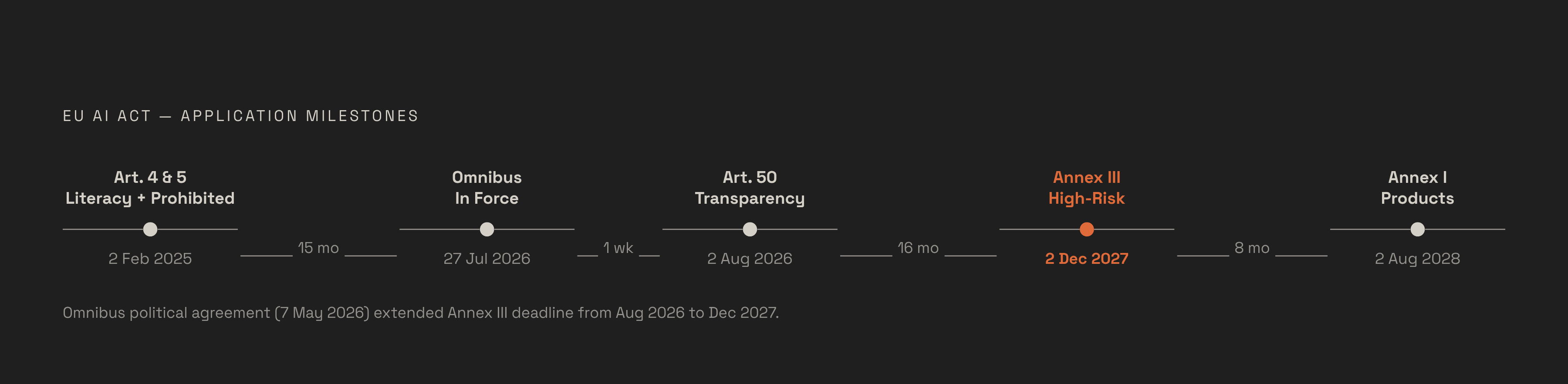
Autonomous emergency braking and similar vehicle safety components fall within the product-embedded track, with notified-body involvement where sectoral legislation requires it. The deadline for Annex I product-embedded systems is 2 August 2028 under the Omnibus agreement. Existing quality management provides a starting point. Where an IATF 16949 system already operates, the guidance is to integrate AI requirements rather than duplicate the quality management structure.
Legal deployments place greater weight on professional judgment and confidentiality. Tools used in administration of justice are high-risk under Annex III, including legal research tools that help with decisions. Deployment must preserve attorney-client privilege across matters, avoid displacing lawyer-of-record judgment, and address disclosure of AI use. Multinational operations face a parallel ethical framework. ABA Formal Opinion 512 provides US-side advisory guidance, but it is not binding law.
A diagnostic agent whose intended purpose meets the definition of a medical device is covered by both the Medical Device Regulation and the AI Act. Clinicians must be able to understand the rationale behind diagnostic recommendations. Incident reporting can also overlap. A compromised connection exposing patient data could engage NIS2’s 24-hour early warning to the CSIRT and GDPR’s 72-hour supervisory notification, with DORA’s separate timeline relevant where a financial entity is involved.
The classification problem: identifying which deployed systems are actually high-risk
Classification precedes every high-risk obligation described above. Enterprises can deploy systems within Annex III without recognising their regulatory status, leaving the applicable operational requirements unaddressed. Recruitment screening, customer service routing, and document processing in regulated industries may qualify, depending on how they are used. The employment and essential-services categories cover uses that compliance teams might otherwise see as routine help with workflows.
An appliedAI analysis found that a substantial share of enterprise AI systems could not be clearly classified under the Act’s risk tiers. That ambiguity creates a practical dependency. Without a classification determination, the enterprise cannot reliably decide which evidence, oversight arrangements, or assessments it needs. Prudent practice is to treat potentially high-risk systems as high-risk until a formal determination is made.
A systematic inventory is the prerequisite for that determination. Most enterprises lack one, so the classification exercise often has not begun across the full deployed estate. The initial gap is therefore informational as well as legal. Compliance teams need a defined set of systems and uses to assess before they can apply the Act consistently.
Where the harmonised standards gap leaves deployers right now
The absence of published harmonised standards removes the clearest engineering benchmarks for compliance, but it does not suspend deployer obligations. At the source publication dates, no notified bodies had been formally designated under the Act either. In these conditions, compliance programmes must work directly from the regulatory articles and use Annex IV’s technical documentation framework as their main engineering reference.
The European Commission identifies 7 May 2026 as the date of the Omnibus political agreement extending Annex III high-risk obligations to 2 December 2027. The agreement also deferred Annex I product-embedded obligations to 2 August 2028, and the Omnibus entered into force on 27 July 2026. Those dates change the implementation schedule. They do not reduce the programme’s scope.
Other requirements follow their own application dates. Article 4 on AI literacy and Article 5 on prohibited practices applied from 2 February 2025, while Article 50 transparency requirements applied from 2 August 2026. The high-risk deferral is therefore not a general pause on AI compliance. The programme required by December 2027 remains the same programme that would have been required by August 2026.
Building an AI operations audit as the foundation of deployer compliance
A formal AI operations audit turns these requirements into a prioritised readiness programme. Its first phase covers system inventory and classification, data maturity, infrastructure, talent and literacy, and governance posture. The output is a gap list tied to the Act’s documentation requirements.
The resulting compliance file brings together technical documentation, risk management and data governance records, instructions for use, declaration verification, automatically generated logs, and the relevant post-market monitoring plan. Much of what these records contain is also in the documentation that specialist AI liability underwriters require. For agents that learn continuously or retrain frequently, the audit must define how changes are judged material enough to trigger classification or conformity reassessment. Monitoring infrastructure, incident reporting, log retention, and quality management maintenance also need explicit operating budgets.
The review must also settle who is responsible for implementation before customisation begins. Eigenomic, an enterprise AI agent builder that owns complete workflows and ships them to production in weeks, is one implementation partner that can be asked to establish who counts as provider and deployer for a proposed agent before changes are made. The same role determination is necessary with any implementation partner. To prepare for 2 December 2027, enterprises should begin inventory and classification now, then use the findings to fund and assign the ongoing compliance work.
Notes
- EU AI Act High-Risk Deadline: Enterprise Readiness Gap
Informed the discussion of the enterprise readiness gap, including missing AI inventories, classification ambiguity, the standards and notified-body gap, and the Omnibus deadline extensions.
Every new piece from Hallucination Report, as it's published.
Follow