EU AI Act High-Risk Classification for Enterprise Workflow Agents
Any Annex III task in a workflow can make the whole agent high-risk.
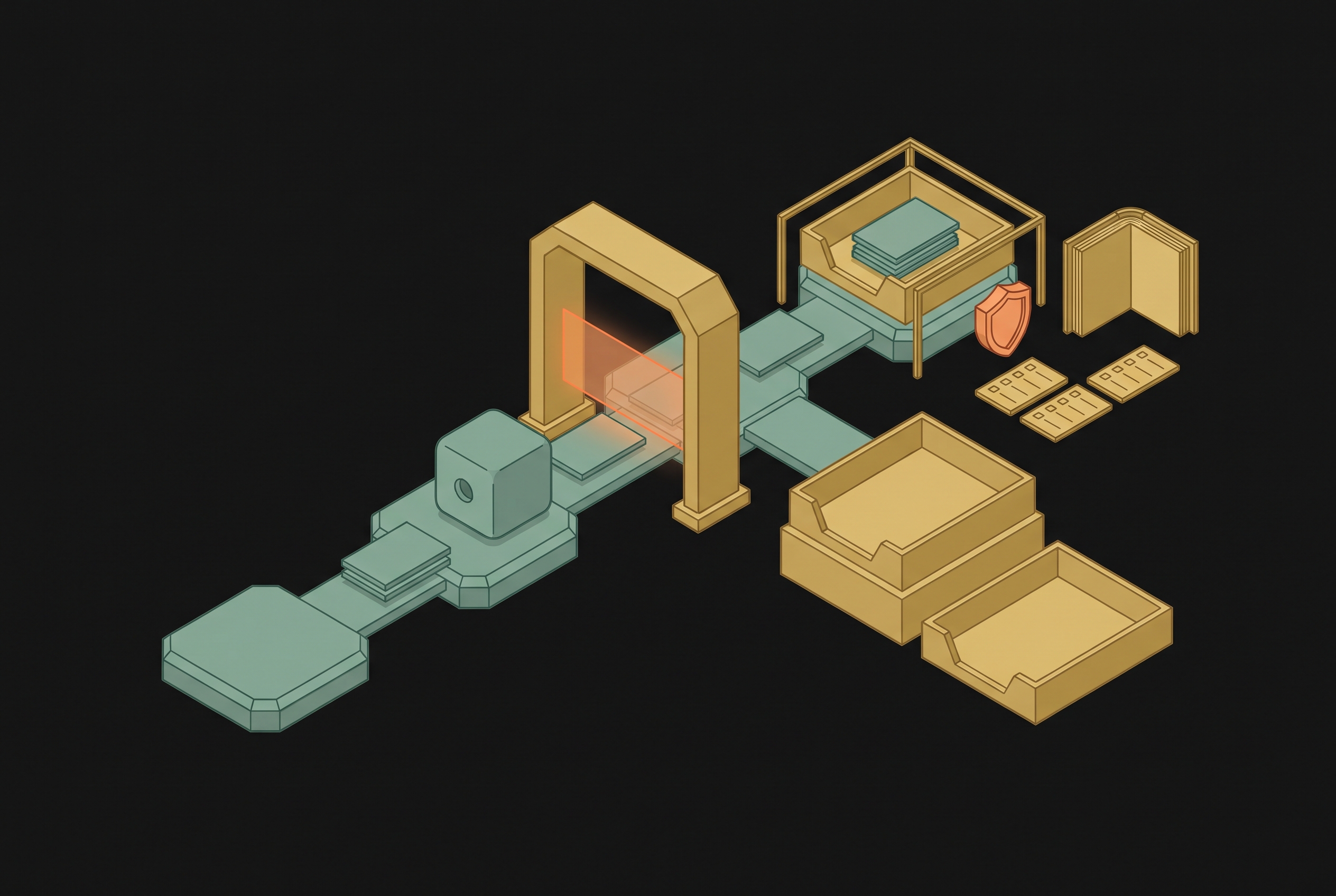
Enterprise workflow agents face EU AI Act high-risk classification because of what they do. When a task or sub-agent brings a workflow into an Annex III domain, the relevant obligations attach to the whole system. Understanding that inheritance is the foundation for compliance, because it determines what enterprises must classify, document, monitor, and place under human oversight.
How the EU AI Act classifies AI systems — and why agents don't get their own category
The EU AI Act (Regulation (EU) 2024/1689) classifies AI systems by the risk of their intended purpose. It distinguishes unacceptable, high, limited, and minimal risk, with a separate regime for general-purpose AI models. Architecture does not determine the tier. The word “agent” appears nowhere in its 113 articles, so agents are assessed as ordinary AI systems under Article 3(1).
High-risk classification follows two routes. Annex III covers specified uses, including employment, essential services, education, biometrics, critical infrastructure, law enforcement, migration, and administration of justice and democratic processes. Annex I covers AI safety components in products already subject to EU harmonisation law. Those routes have different deadlines and obligation structures. Because purpose governs classification, enterprises need to ask not “is this an agent? but “what does this system do, and for whom?”.
Why composing capabilities is what makes workflow agents a classification problem
A workflow agent can cross risk tiers within one execution. It might book a meeting, draft a client email, and then adjust a salary-review recommendation under Annex III point 4. An orchestrator adds another layer by coordinating sub-agents that each seem to have a narrow task. The classification problem lies in their composition. Assessing each component separately would miss what the complete workflow does.
Article 6(3) allows some preparatory or procedural systems in Annex III domains to qualify as non-high-risk, but it does not exempt a multi-step agent merely because its components perform narrow tasks. A system profiling natural persons within an Annex III domain cannot use that exemption. Other claims still require EU database registration and a documented rationale available to authorities. Following the Digital Omnibus deletion of Annex VIII Section B, point 7, that rationale is no longer submitted with the database entry.
The inheritance rule and how the May 2026 Commission guidelines closed the split-architecture escape
When a task or sub-agent performs an Annex III function, that domain’s obligations attach to the entire system. The Commission’s May 2026 draft guidelines explicitly stated that split architectures cannot avoid high-risk classification and extended that principle to agentic systems coordinating interconnected actions. Article 9(1) also requires risk management to account for “the level of autonomy”. Greater independence therefore demands stronger controls.
The Digital Omnibus (Regulation (EU) 2026/1744), published on 24 July 2026 and in force from 27 July 2026, changed the timetable without softening substantive requirements. Annex III obligations apply from 2 December 2027, while the Annex I product route applies from 2 August 2028. Since 2 August 2026, Article 50 transparency duties have applied and the Commission has had powers to enforce the rules for GPAI models. The Omnibus also expanded AI Office powers, including on-site inspections. The remaining preparation window is shorter than it appears, because compliance infrastructure takes months to build.
Provider versus deployer — how the role an enterprise plays determines which obligations fall on it
Classification establishes the system’s obligations, but role determines who bears them. Under Article 3(3), an enterprise developing an agent on a third-party model API and putting it into service under its own name is the system provider. An enterprise that instead buys a ready-made assistant for professional use is a deployer under Article 3(4). The model supplier’s GPAI obligations under Articles 53–55, applicable since August 2025, do not transfer to the enterprise building on top.
Article 25 creates the accidental-provider trap. A deployer becomes a high-risk system provider if it rebrands or substantially modifies a system, or changes a non-high-risk system’s purpose so that it becomes high-risk. Connecting a general-purpose chatbot to recruiting is such a purpose change. Deployers retain separate Article 26 duties covering instructed use, competent oversight, relevant input data, log retention, and notifications.
How high-risk classification attaches in healthcare — the two-route problem
Healthcare exposes the practical consequences of the two routes. Standalone patient triage, emergency-care decision support, and benefits-eligibility systems follow Annex III, with full Chapter III Sections 1, 2, and 3 obligations from 2 December 2027. AI embedded in CE-marked devices governed by the Medical Device Regulation or In Vitro Diagnostic Regulation follows the August 2028 route. Scheduling and ambient documentation tools do not automatically enter either category. Duties on transparency, AI literacy, and prohibitions still apply to these tools.
Agents allocating shifts, evaluating staff, or screening applicants fall under Annex III point 4, just as they would in another sector. Agents that route patients or check service eligibility may fall under point 5. If the enterprise also uses AI in a Class II or Class III medical device, it faces parallel compliance tracks. The later device deadline does not defer the employment or essential-services obligations.
How high-risk classification attaches in automotive — safety components versus back-office agents
Emergency braking, lane-keeping, and safety-relevant perception reach Annex I through the safety-component test, which asks whether failure or malfunction would directly create a risk to health and safety. The product route is specific. For a Tier-1 supplier delivering an AEB and lane-keeping perception stack to OEMs, Article 2(2) makes Article 6(1) and Articles 102–109 and 112 directly binding. The substance of Articles 8–15 reaches it through the amended type-approval framework, with an August 2028 deadline.
For safety-component compliance, the integration task is to use ISO 26262, SOTIF, ISO/SAE 21434, UN R155, and UN R156 as evidence. That vehicle work provides no cover for HR agents. Recruitment and selection fall under Annex III point 4(a), while promotion, task allocation, performance evaluation, and termination fall under point 4(b). Dealer-network workforce management and inventory-driven staffing agents can therefore trigger the full high-risk stack from December 2027, independently of vehicle compliance.
How high-risk classification attaches in legal — why deployment context, not tool capability, determines the tier
A legal research agent used for internal law-firm drafting is likely limited risk, while the same tool supporting sentencing in a court is high-risk under Annex III. Deployment context changes the classification. Firms must therefore assess how they intend to use the tool and how their institutional clients redeploy it, which can trigger Article 25’s provider-role change. Technical capability alone cannot settle the question.
Professional safeguards operate alongside the Act. Privilege preservation, matter isolation, client disclosure, and lawyer-of-record judgment remain relevant, while GDPR Article 22 adds protections for solely automated decisions producing legal or similarly significant effects. Unsanctioned research, drafting, or document-review tools complicate that assessment. Shadow AI can put privilege at risk and create duties for tools the enterprise has yet to add to its inventory.
The full obligation stack that high-risk classification triggers, and how autonomy level scales the burden
For Annex III providers, Articles 9–17, 43, and 49 require risk management, data governance, technical documentation, automatic logging, instructions, human oversight, accuracy and robustness measures, a quality management system, conformity assessment, and EU database registration. The legal stack is fixed. Under Article 9(1), the work needed to meet that stack grows with autonomy, so autonomy helps set priorities for compliance spending while all the requirements still apply.
A copilot whose actions a human approves at every step needs the least work to meet that stack. A supervised agent needs written limits on what it can do and logs that cover every decision point. A fully autonomous agent also needs its behaviour monitored continuously after deployment and reliable ways for people to intervene. Documentation must cover the complete agentic system. Article 12 records cannot be produced for unobservable agents, and a system prompt is not an Article 14 oversight control.
Existing quality systems should be extended. ISO 13485 and IATF 16949 can supply evidence for medical-device and automotive requirements, but conventional implementations rarely cover adaptive behaviour after deployment. Agent governance must fill that gap. The quality system’s scope must therefore reach beyond development into the operating lifecycle.
What the classification process looks like in practice — a four-check framework for each agent
The method starts with an inventory of each agent’s intended purpose, deployment context, data inputs and outputs, and the business owner who is accountable for it. Discovery precedes any defensible classification decision. The four checks then apply to the complete system and repeat when purpose, tool access, capability, or organisational context materially changes.
The first check is Article 5 prohibition compliance, applicable since 2 February 2025. It covers practices such as harmful manipulation, exploitation of vulnerabilities, social scoring, and prohibited biometric uses. Workplace emotion inference is prohibited outside narrow medical or safety exceptions. An agent that fails this check needs redesign. High-risk controls cannot legitimise a prohibited use.
The second check maps the surviving use case to Annex III, including recruitment, worker management, creditworthiness, life and health insurance pricing, education, benefits, and judicial decision support. The third then tests Article 6(3). A narrow procedural or preparatory function may qualify, as may improving completed human work or detecting deviations without replacing human review. Profiling natural persons rules out the exemption. Any claimed derogation still requires registration and documented reasoning.
The fourth check assesses Article 50 transparency regardless of the high-risk result. Conversational agents must disclose AI interaction by the first interaction unless it is obvious from context. Generative-system providers must also mark synthetic content in machine-readable form. For systems placed on the market before 2 August 2026, that marking is due by 2 December 2026.
Why AI Operations Audits are the structural answer to the classification and inheritance problem
Continuous classification depends on operational visibility, which makes an AI Operations Audit a structural response. The audit tests intended purpose and business value, data quality and permissions, governance, security, integration architecture, evaluation, escalation, ownership, and operating cost. Each use case needs an accountable owner. A baseline metric, an accuracy and failure-handling test set, and a human escalation path make the system assessable.
That assessment must include unsanctioned tools as well as approved deployments. Recruitment screening or regulated document processing can look like ordinary productivity work even as it adds high-risk functions. Discovery therefore establishes the boundary that inheritance follows. Without it, enterprises cannot reliably tell what classification and the extension of their quality system must cover.
Governance tooling can automate parts of the resulting infrastructure. OneTrust provides AI system and agent inventory capabilities, while Modulos automates risk and compliance workflows. Drata’s AI Agent Governance was described as Limited Availability for qualified enterprises running agents on Anthropic as of October 2026. These tools support an established inventory and classification. They do not remove the need to determine purpose, responsibility, and the post-deployment behaviour that governance must cover.
What enterprises with agents in Annex III domains must have in place before December 2, 2027
By 2 December 2027, Annex III providers need controls that work as well as policies that describe them. Risk management must account for how independently the system acts, data governance must cover the inputs it uses in operation, and technical documentation must include sub-agents and tool calls. Event-level logging and human intervention must operate. Accuracy and robustness testing, an extended quality system, conformity assessment, and database registration must also be complete.
Deployers need their own evidence that they follow instructions for use, have competent people providing oversight, check that inputs are relevant, and keep logs for at least six months. For workplace deployments, deployers must keep records that workers’ representatives were notified where required, and must have processes to notify affected individuals. These duties remain separate from provider conformity. Prohibition compliance, AI literacy, and the applicable transparency and marking deadlines cannot wait for December 2027.
The build sequence follows those dependencies. Discovery and system-level classification precede role determination, including examination of Article 25 purpose changes. Enterprises must act now to meet Article 50 duties that are already due, as transparency breaches can bring fines up to €15 million or 3% of worldwide turnover. High-risk infrastructure then proceeds through policy evaluation, logging, oversight, bias and fairness testing, documentation, and post-market monitoring. Enterprises building this from scratch are establishing the operating discipline that a rigorous AI operations practice treats as standard.
The central task is making the complete workflow governable.
Notes
- EU AI Act Unpacked #32: Draft Commission Guidelines on “High-Risk” AI
Covered the Commission's draft high-risk guidelines, including the position that split architectures cannot avoid high-risk classification and that this extends to agentic systems.
Every new piece from Hallucination Report, as it's published.
Follow