Review Queue Design for AI-Generated Clinical Documentation
How to sort AI-drafted notes so physicians review risk, not everything.
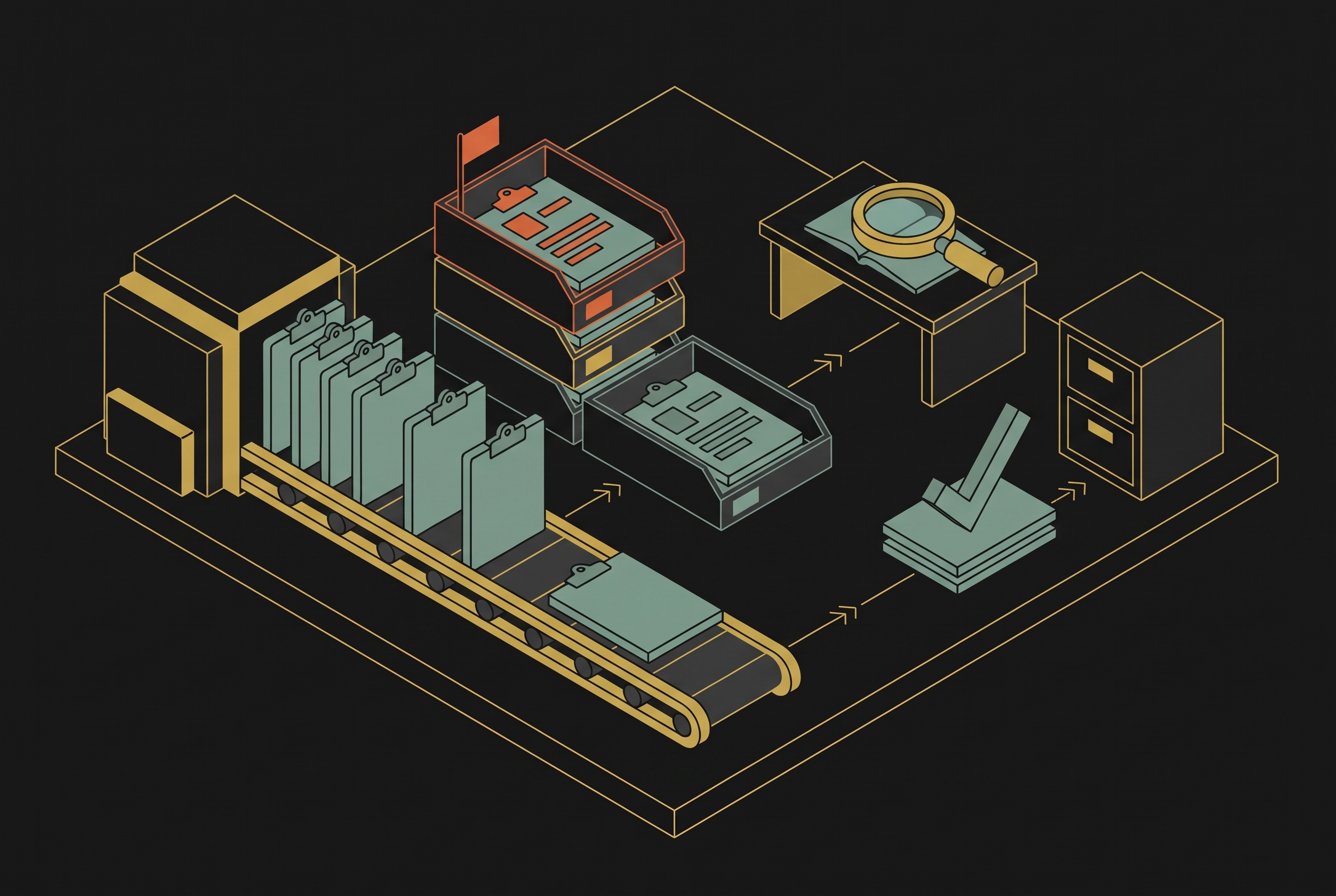
AI-generated clinical documentation reduces physician burden only when its review queue makes drafts usable, directs attention to clinical risk, and provides a clear path for unresolved problems. Queue design is therefore part of the clinical workflow. Its success depends on the review interface, escalation rules, production infrastructure, and evidence that physicians are spending less effort on documentation.
Why the review queue is a workflow design problem, not a compliance checkbox
After a clinical session, a physician faces a queue of AI-generated notes that each need to be reviewed and signed. The drafts may already read fluently. Yet the physician still has to check the drafts for accurate representation of the encounters, assessments that reflect clinical thinking, and plans that match the orders placed. The physician must still sign off on every note. That work demands some of the physician’s remaining time and attention.
An unstructured draft can leave the physician reorganising information before substantive review even begins. The same displacement occurs when a queue presents every item as an undifferentiated task, leaving the clinician to discover both the problem and the appropriate response.
The queue has three distinct workflow problems to solve. Routing errors bring work to the physician unnecessarily, substantive errors require correction rather than confirmation, and unresolved risks require escalation before signature. These problems demand different responses, even when they appear in the same draft. A queue designed chiefly to collect signatures obscures those differences. A queue designed around the work makes them explicit before they consume the clinician’s attention.
The error classes that queue design must handle
Omissions, inaccuracies, and hallucinations place different demands on review. An omission leaves out information needed to represent the encounter adequately. An inaccuracy misrepresents a clinical detail without necessarily inventing content, while a hallucination introduces content that was not present in the encounter. Restoring missing information, correcting a factual detail, and establishing whether a statement has any basis are different tasks.
Omissions are particularly difficult to review through prose alone because the missing information is not visible in the draft. Inaccuracies instead require comparison between what the note says and the clinical detail it should represent. Hallucinations raise a further question about provenance. A reviewer must check for supporting evidence for the content before deciding how to rewrite it. Treating these tasks identically forces the physician to apply the same depth of scrutiny regardless of the suspected failure.
Error class alone cannot show how serious an error is in clinical terms. Whether a note is correct also depends on the patient history, clinical domain, encounter type, and documentation conventions. A minor phrasing omission and an omitted detail essential to the assessment cannot reasonably receive the same priority just because both are omissions. At the same time, making a minor omission and a suspected hallucination stand out equally can lead physicians to spend too long on low-risk items and too little time on real risks. The resulting alert fatigue is a design failure.
What structured evaluation methodology reveals about where human review is essential
Canvas Medical and Stanford’s Case-Specific Rubrics for Clinical AI Evaluation study offers evidence for review that takes clinical context into account. The study tested seven versions of an EHR-embedded AI agent on 823 clinical cases in primary care, psychiatry, oncology, and behavioral health. The clinicians who wrote the rubrics made them case-specific instead of using one broad definition of note quality. Those rubrics could tell high-quality outputs from low-quality ones, with median scores reaching 95% across agent versions. Structured evaluation made iterative improvement measurable.
The study also found imperfect agreement among expert clinicians about adequate documentation. That limits what a universal review standard can accomplish. What a specialty expects, how much risk clinicians accept, and their views on documentation shape judgments that may look like simple checks of whether a note is correct. Review support in the queue must preserve clinical context. Human judgment remains essential where adequacy depends on the encounter.
LLM-generated rubrics achieved scoring agreement with clinician-authored rubrics at roughly one-thousandth of the cost. That finding opens a path to automated pre-screening through case-specific rubric logic that could flag likely error types and severity before a clinician opens a note. The design objective is proportional review effort. Automated evaluation can point to a possible problem while the physician decides how much it matters clinically and how to resolve it.
Interface decisions that separate fast, safe review from cognitive overload
For clinical informatics and deployment teams, the first interface requirement is visible provenance. AI-generated content must be clearly distinguishable from physician-confirmed content, with an audit trail separating generated material from physician-written changes. This distinction belongs at the point of review. A clinician should not have to infer authorship from writing style or leave the review screen to establish whether a passage has been confirmed.
The interface should reinforce the clinical scan sequence. That sequence includes checking the HPI for accuracy, confirming the medication list, verifying that the assessment matches clinical thinking, and comparing the plan with the orders actually placed. The assessment and plan deserve particular prominence because their clinical substance makes the draft useful. Preserving the scan sequence does not require burying its highest-stakes content.
Pre-sorting by inferred omission, inaccuracy, or hallucination risk allows low-risk items to move through confirmation while flagged items receive active evaluation. Low risk must not mean exempt from review. Clinical reasoning support, including differential diagnosis and assessment-and-plan recommendations, can support confirmation, but those recommendations also require clinical judgment. In the dialectical review model, the physician critically evaluates and contextualises the algorithmic output, then endorses or overrides it. Removing that encounter between output and judgment in pursuit of speed removes the queue’s safety mechanism.
Escalation logic and the conditions that should stop a note from being signed
Three conditions should trigger escalation before signature. These are an unverifiable hallucinated clinical detail, a generated assessment that conflicts with an order already placed in the EHR, and a medication or diagnosis absent from the structured patient record. Each presents a discrepancy that requires resolution before the note proceeds. A warning alone does not resolve the work. The queue must define who receives the escalated note, the response SLA, and what constitutes resolution.
OI Infusion Services illustrates the structural principle through its prior-authorisation deployment, which handles standard cases autonomously and routes complex or incomplete cases to human staff. The relevant parallel is the triage-and-escalate architecture. For documentation, that architecture depends on live EHR integration. Without access to medication lists, active orders, and problem lists, the queue cannot reliably detect the conflicts its escalation rules are intended to catch.
Florian Odi Stummer’s 2026 architecture paper, Ontology-Aware Design Patterns for Clinical AI Systems, proposes related controls at the data layer. Its Reification Circuit Breaker pattern interrupts feedback loops in which AI outputs could reinforce coding artefacts back into training data. Its Drift Sentinel pattern monitors semantic drift in clinical terminology over time. A designated agent owner adds human oversight, with set response SLAs and the authority to take the system out of queue operation.
Why compliance infrastructure is part of queue architecture, not a separate workstream
A review queue needs HIPAA Business Associate Agreement coverage, audit trails, and role-based access controls to work with production patient data. Consumer AI plans lack the enterprise safeguards needed for this use, which must instead be available through the relevant enterprise or API tier.
The audit trail also makes escalation accountable. Without a record distinguishing AI-generated content from physician modifications, the organisation and clinician cannot reconstruct how a disputed statement entered the note. Clinicians must be able to see the AI origin of the material they are signing. An interface that hides that distinction weakens the conditions for informed clinical confirmation.
Compliance also depends on the assumptions embedded in clinical terminology. Stummer’s Terminology Version Gate and Regulatory Compliance Adapter patterns address the possibility that terminology drift and regulatory change invalidate assumptions built into generated output. These controls extend beyond access permissions. A queue operating on stale ontologies can produce records that appear compliant while remaining clinically incorrect. For operations leads, access, traceability, terminology, and regulatory adaptation belong within the queue’s operating architecture.
The production readiness gap that keeps well-designed queues from going live
A working pilot does not establish production readiness. A queue can have a coherent interface and sensible escalation rules while the organisation lacks the evaluation infrastructure, monitoring tools, and ownership needed to operate it at clinical volume. Healthcare puts AI agents into production at a lower rate than banking and insurance, reflecting a wider gap in how much non-deterministic behaviour regulators allow and in the infrastructure set aside for AI operations. The transition is not simply a software release. It requires an organisation capable of detecting and responding to failure.
For a health system preparing that transition, a production readiness framework requires a centralised registry of deployed agents, including permissions, data access, and last evaluation date. Each production system also needs a designated owner with response SLAs. Quarterly capability reviews should include a random audit sample, and a formal deprecation process must govern withdrawal. These controls make responsibility explicit. They also give evaluation findings an operational destination rather than leaving them as observations without an owner.
The rubric study shows how field-level validation can support production through repeated comparisons tracking what changes from one agent version to the next. Data condition is an equally important input. Documentation AI that depends on current, structured EHR information can fail silently when that information is stale, incomplete, or ontologically distorted. A readiness assessment must expose those conditions before deployment, because a well-designed review interface cannot by itself repair the data on which its judgments depend.
Measuring whether the queue is actually working once it goes live
Teams need a baseline they can trust before deployment to measure how the queue performs. The minimum set includes time-to-sign per note by note type and specialty, correction rate by omission, inaccuracy, and hallucination, escalation rate and resolution time, and physician-reported review burden on a standardised scale. Signing activity alone is insufficient evidence of success. These measures distinguish speed from effort, and completed work from unresolved clinical risk. Without them, it is hard to tell whether a shorter queue means the system is working better or review is less effective.
Correction rate is the most informative single metric because it reveals several aspects of performance at once. When tracked by error class and clinical context, it can show whether output is getting better, whether some encounter types or specialties are still hard to handle, and whether risk stratification draws attention to the right items. The rubric study produced over 216,000 scored note-rubric pairs using clinician-authored rubrics validated against real-world and synthetic cases. That offers a way to keep evaluating output beyond what experts can review on their own. Such evaluation complements operational measures.
For clinical leadership, the return is not merely time saved but physician time redirected toward patient care, reduced after-hours work, or throughput. Those outcomes require comparison with the original baseline. An AI Operations Audit can then assess whether the system is ready to scale, whether governance is adequate, and whether the queue is reducing burden as intended. Clinical operations leads should track corrections, how escalations are resolved, how much work review takes, and after-hours documentation together.
Notes
- Case-Specific Rubrics for Clinical AI Evaluation: Methodology, Validation, and LLM-Clinician Agreement Across 823 Encounters
Supplied the case-specific rubric study: 823 cases, clinician disagreement on adequacy, LLM-rubric agreement at low cost, and the 216,000 scored note-rubric pairs.
- Ontology-Aware Design Patterns for Clinical AI Systems: Translating Reification Theory into Software Architecture
Provided the ontology-aware design patterns (Reification Circuit Breaker, Drift Sentinel, Terminology Version Gate, Regulatory Compliance Adapter) discussed for data-layer controls.
- Measuring the Quality of AI-Generated Clinical Notes: A Systematic Review and Experimental Benchmark of Evaluation Methods
Informed the discussion of error classes (omissions, inaccuracies, hallucinations) and of how to evaluate the quality of AI-generated clinical notes.
- Generative AI in Medicine
Supported the points on clinical reasoning support and the dialectical review model, in which physicians critically evaluate algorithmic output.
- End-to-End Evaluation and Governance of an EHR-Embedded AI Agent for Clinicians
Provided the governance and production-readiness material: agent registry, designated owners with response SLAs, quarterly audits, deprecation, and the EHR-embedded agent evaluation.
Every new piece from Hallucination Report, as it's published.
Follow