Switching Foundation Models in Production Without Accuracy Regression
A baseline, canary gates, and tested rollback keep model swaps safe.
Switching foundation models in production without accuracy regression is achievable, but it requires an operational process. Pre-migration evaluations establish the comparison, semantic layer integrity protects the context, and monitored canaries expose failures before full deployment. Tested rollback makes that process reversible.
Why model switches fail in ways that don't look like failures
A provider’s deprecation deadline can force a migration before a team is ready to make one. OpenAI publishes shutdown dates and recommended replacements, while Anthropic distinguishes Deprecated and Retired statuses. The deadline is not evidence of quality. Under time pressure, however, a working integration can be mistaken for a successful migration, even as accuracy quietly declines.
The component being replaced generates responses from system instructions, conversation context, retrieved sources, and tool outputs. It is not the retrieval index. Unlike an embedding model migration, which requires re-vectorization, a foundation model switch requires behavioral testing. Even a minor update can weight instructions differently, produce longer answers, change structured output formatting, or invoke tools in another order. These changes can damage grounding, safety, latency, and cost without producing an error on an uptime dashboard.
This is also a recurring operational obligation. Models at comparable capability tiers now deliver similar performance on many enterprise tasks, giving teams reasons to switch for cost, latency, or compliance. Each replacement nevertheless interprets the application’s inputs through different behavior. Broad capability parity does not establish equivalence within a particular workflow.
What the semantic and retrieval layer does to accuracy — and why it breaks first
The semantic layer is a dominant determinant of enterprise LLM accuracy because it gives the model governed context. Without that grounding, accuracy can collapse even when the model itself is capable. During a switch, the risk therefore extends beneath the generator to the context infrastructure on which its answers depend.
Longer context windows can change which chunks receive attention, different tokenization can affect structured data parsing, and instruction-following differences can change how metadata fields are interpreted. An unchanged retrieval index does not guarantee unchanged grounding. Meanwhile, unmonitored embedding quality, versioning, and refresh cycles may already have allowed retrieval quality to drift before the replacement model arrives.
As base model capabilities converge, retrieval quality becomes a stronger determinant of user experience. Reranking and hybrid search address that pressure through query optimization, but their contribution must remain distinguishable from the generator’s behavior. Otherwise, a migration inherits an attribution problem. If retrieval and generation change together, a worse answer does not reveal which change caused it.
Building the pre-migration evaluation baseline
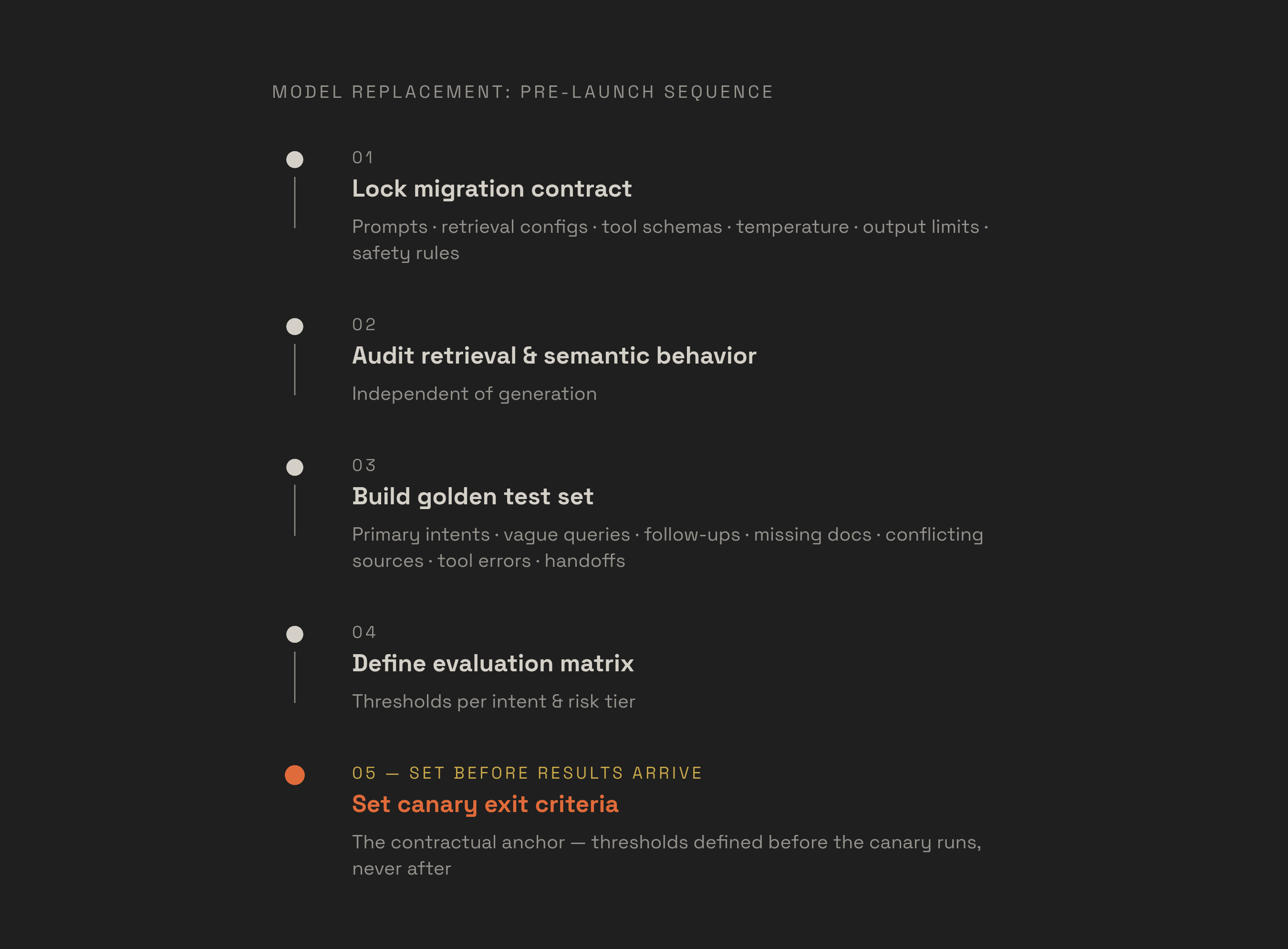
The first operational step is to establish a baseline before testing any replacement. Without it, later degradation cannot be separated reliably from normal variance. Begin by defining a migration contract that locks system prompts, retrieval configurations, tool schemas, temperature, maximum output length, and safety rules. Document unavoidable parameter adjustments. Use explicit model version identifiers so that the comparison has stable subjects.
Next, audit retrieval and semantic behavior independently of generation. That separation makes the comparison interpretable. Build a golden test set from anonymized or synthetically generated cases that reflect actual traffic, including primary intents, vague questions, follow-ups, missing documents, conflicting sources, tool errors, and requests requiring human handoff. Group those cases by language, device, user persona, and risk tier. A strong aggregate score must not conceal a weak result in a business-critical subset.
Then define an evaluation matrix with thresholds for each intent and risk level. Score tone, completeness, source grounding, structured output accuracy, tool invocation order, and latency separately, using explicit rubrics and domain-expert calibration for subjective judgments. Lower token prices cannot offset weaker grounding. Risk tiers also set the pace of the rollout, so an FAQ chatbot can enter early canary testing while order modifications, contract inquiries, and sensitive support tickets stay on the baseline longer.
Distribution shift as the failure mode that benchmarks miss
A representative test set is necessary, but it cannot establish performance on every production input. Distribution shift happens when live requests fall outside the evaluation distribution, even if they differ only a little from familiar examples. Task completion can then fall sharply. A 95% score on curated cases and a much lower score on novel edge cases can coexist without any contradiction in the measurements.
The operational implication is that passing evaluations cannot be the final release gate. Live monitoring needs its own segment-level logic. It must track the tasks that justify deployment, such as clause identification, structured extraction from clinical notes, and automotive inventory classification. Confidence in the aggregate offers no protection against a narrow failure. High-volume, low-risk decisions should reach full automation only after sustained production monitoring establishes accuracy above the required threshold, without shortening that window because offline results look reassuring.
Running a canary rollout with meaningful exit criteria
Microsoft’s Copilot Studio documentation says that agents using the Default model get upgrades automatically when the default changes. An agent can therefore move to a new model without a team initiating a migration. The production exposure has already happened. At the scale of hundreds of thousands of organizations using the platform, default aliases make model lifecycle management an ongoing operating requirement. High-volume agents should select a specific model version and subject each change to its own evaluation cycle.
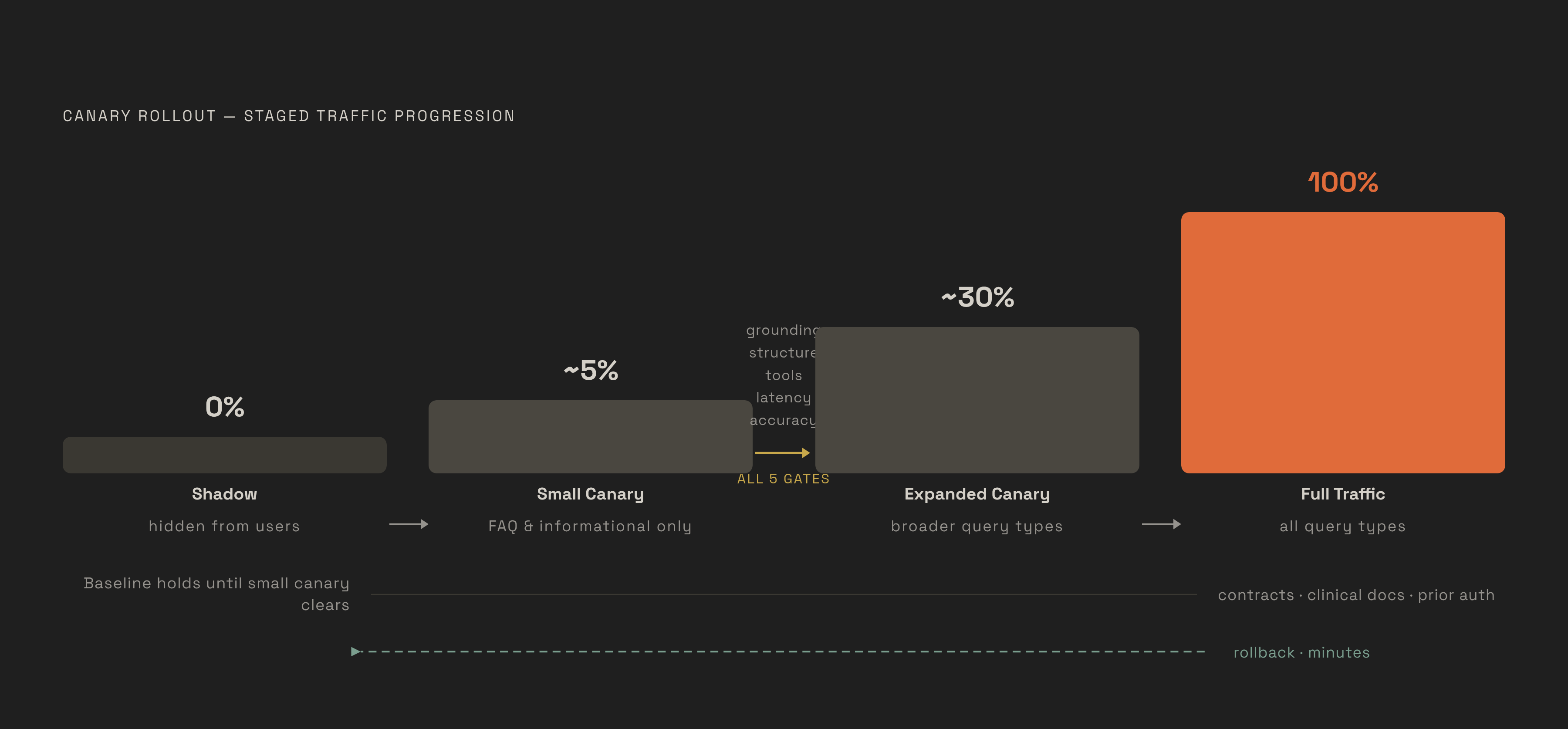
A controlled canary makes that exposure deliberate. Shadow testing sends the same inputs to two models but keeps the candidate’s answers from users, while a canary gives those answers to a defined user segment and measures live outcomes. Shadow mode cannot show the full effect of how real users behave. A safe rollout therefore routes a small percentage of traffic to the candidate under monitoring, with a tested rollback mechanism available.
The initial segment should contain low-risk, high-volume interactions such as FAQ and informational queries. Contract modifications, clinical documentation, and prior authorization processing must stay out of the rollout until the low-risk canary passes its quality gates. Those gates must be set before results arrive. Exposure can expand only when source grounding, structured output accuracy, tool invocation correctness, latency, and accuracy within risk-tiered subsets meet the quality gates. Deciding afterward that results look acceptable would replace the migration contract with a retrospective judgment.
Rollback readiness as an operational discipline, not a contingency plan
A rollback mechanism that has not been tested before the canary is an untested recovery hypothesis. It offers little assurance when a live regression removes the time needed for deliberate testing. Readiness requires an accessible, production-validated baseline pinned to an explicit version identifier and routing that can redirect traffic within minutes. It also requires predefined triggers identifying the metric and threshold that initiate rollback without escalation. Recovery must be executable before exposure begins.
In regulated workflows, restoring accuracy is only part of recovery. The rollback must also keep audit logging, data residency guarantees, and access controls in place. A traffic switch that breaks one of those properties has not restored a valid production state. These requirements belong in rollback testing, rather than in an investigation after the baseline resumes serving requests.
If a single provider accounts for more than 60% of an organization’s AI surface, acquisitions, outages, or policy changes create concentration risk and can force an unplanned switch. An accessible baseline alone does not resolve that dependence. Model-agnostic architecture places the model call behind a routing layer that can redirect to another provider, supporting future migrations without rebuilding integration patterns.
Where regression bites hardest: legal, healthcare, and automotive workflows
In legal document analysis, narrow task accuracy is the basis of the business case. An agent does the document review, clause identification, and change tracking that people would otherwise have to do by hand. A replacement can keep the same overall benchmark score even as its clause-identification accuracy falls. The narrow task has lost its value. Switching without rerunning intent-level evaluations can therefore reverse the cost savings the deployment was intended to produce.
In healthcare, a change in how the model parses clinician notes can degrade the structured extraction needed for clinical documentation and prior authorization processing. That extraction must be accurate for turnaround to be faster and denial rates to be lower. Provider differences in data residency guarantees and audit logging add a separate constraint, because improved extraction cannot compensate for a broken compliance property.
Automotive inventory agents need structured outputs that stay consistent as they assess pricing signals, days-on-lot patterns, and trim-level demand. A model that changes the output format can break downstream decision logic even when its answers appear comparable. Comparable prose is not a sufficient acceptance test. Manufacturing quality control has a related exposure through classification accuracy, where degraded defect detection undermines throughput and warranty claim reduction. These consequences make the migration controls a minimum protection for business outcomes.
The AI Operations Audit as the prerequisite that makes the playbook executable
The playbook assumes instrumented workflows, governed data, and evaluation infrastructure that many enterprises have not yet built. Without them, the team cannot establish a defensible baseline, interpret a canary, or demonstrate that recovery worked. Missing infrastructure is itself a migration blocker. An AI Operations Audit conducted before the switch identifies those gaps and establishes what must be repaired first.
Ontrac’s enterprise AI readiness framework specifies seven dimensions for that assessment. They are strategy tied to P&L outcomes with named owners, a named executive sponsor with explicit decision rights, clean and governed accessible data, defined AI roles and organization-wide literacy, an active governance and usage policy, documented and instrumented core workflows, and teams prepared to absorb process change. These dimensions expose dependencies outside the model integration. A technically sound comparison still needs owners who can define acceptable outcomes and authorize decisions.
AvePoint’s State of AI 2026 research found that organizations that were most confident they could prevent unauthorized data access still had high rates of AI-related access incidents. That finding concerns access controls and illustrates the danger of treating confidence as evidence. Strong alignment with senior analysts is defensible only when their judgments provide a standard against which the agent is measured. The audit establishes whether such foundations exist before migration results depend on them.
Measuring what actually changed after the switch completes
Source grounding and clause-identification accuracy support the assessment of contract review time and legal cost reduction. Structured extraction accuracy supports the assessment of prior authorization turnaround and denial rates. Accuracy in defect detection is linked to manufacturing throughput and warranty claims. A measurement stack that stops at model scores cannot establish whether the migration preserved the business case.
This distinction addresses a wider measurement gap. Many executives report productivity gains from AI, while fewer can confidently measure its ROI. For a model switch, the pre-deployment baseline makes the resulting change measurable. Moving all traffic is only part of completing the switch.
Segment-level tracking must also persist after the switch. Stable overall accuracy can conceal a decline in clause identification, clinical extraction, or inventory classification. The record of the migration should therefore show what was tested, which thresholds were met, what was monitored, and what business outcomes followed. This audit trail provides the starting evidence for the next replacement, reducing the uncertainty that otherwise has to be resolved anew with every model change.
Notes
- The End of the Foundation Model Era: Open-Weight Models, Sovereign AI, and Inference as Infrastructure
Supports the points about open-weight model parity, provider concentration risk, and routing inference through a model-agnostic layer.
Every new piece from Hallucination Report, as it's published.
Follow