Hybrid Search Architecture for Structured and Unstructured Enterprise Data
Combining dense and sparse retrieval makes AI agents reliable across enterprise data.
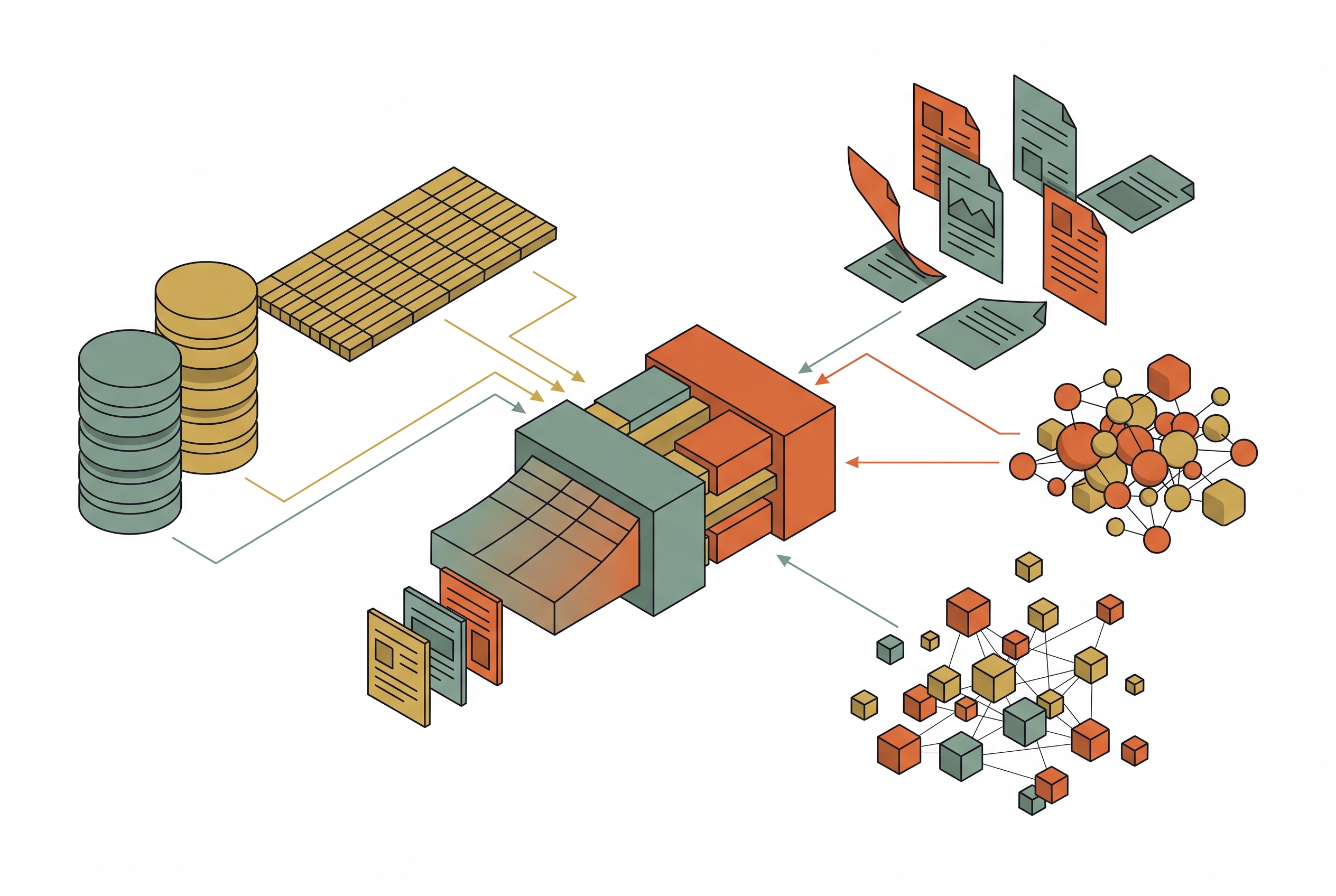
Hybrid search architecture combines dense vector semantic retrieval with sparse keyword search so AI agents can work across structured and unstructured enterprise data. Its design can give agents useful evidence or misleading context. Reliable operational outcomes depend on treating retrieval as the foundation of agent performance, governance, and measurable returns.
Why enterprise AI agents fail when retrieval is wrong
An agent that retrieves the wrong warranty obligation can produce a confident answer that misstates what the enterprise owes. In healthcare, incomplete context can lead to a wrong clinical recommendation. In legal work, a missed clause can become a compliance event. These failures begin before the model reasons over the evidence, because the retrieval layer has already selected the wrong material.
A stronger model cannot fix the choice of the wrong material. When context is wrong or incomplete, the agent lacks the evidence needed to produce a reliable operational result. The gap between running agent pilots and reaching production scale therefore cannot be understood as a model problem alone. Retrieval must handle the actual mixture of enterprise records and documents, rather than only the material that makes a demonstration work. The architecture must retrieve exact facts and the meaning that goes with them, keep track of their sources, and respect who can access them.
What structured and unstructured enterprise data actually look like in production
Structured data is organized around a schema, including relational records, product catalogs, ERP entries, sensor telemetry, and compliance rule sets. Rows and columns support filtering, aggregation, OLAP, and multidimensional analysis. Unstructured material, including contracts, clinical notes, maintenance logs, and regulatory filings, contains information that does not fit those operations in the same way. Yet that text often holds the explanation or obligation an agent needs to interpret a record. Ingestion alone cannot make structured and unstructured data support the same operations.
Automotive agents must connect sensor telemetry to maintenance logs, while legal agents must connect clause databases to contract text and case files. Healthcare agents face the same division between patient records and clinical or prior-authorization documents. An Integrated ETL–OLAP and Semantic Retrieval Architecture for Hybrid Analysis of Structured and Unstructured Enterprise Data identifies the underlying limitation. ETL and OLAP support structured integration and analysis but offer limited semantic access to unstructured text. An architecture must keep both ways of accessing data, because semantic similarity cannot do the work of a structured query, and schema-based processing cannot draw out the meaning in prose.
Why neither pure keyword search nor pure vector search is sufficient
Dense retrieval matches documents through embedding similarity, which helps bridge synonyms, paraphrases, and differences between a user's wording and a document's language. Matching this way can fail when the answer hinges on an exact product SKU, legal citation number, or clinical identifier. Dense representations can lose the distinctiveness of those tokens and smooth over negation, numeric comparisons, or temporal qualifiers. A passage can thus sound like a match yet have no link to the fact the agent needs. Similarity alone also supplies no auditable explanation of why that passage is the correct evidence.
Sparse keyword retrieval, commonly using BM25, handles exact tokens, rare terms, and identifiers more reliably. However, it misses relevant material when a contract describes an obligation in different words from the query. The two approaches thus fail in opposite directions, with one losing precision and the other losing semantic reach. Everest Group's 2026 assessment describes traditional keyword approaches as insufficient for accurate, contextual, and secure information access and identifies the move toward hybrid architectures. Fusion fills the gaps left by each retrieval approach, while governance needs more controls built into the architecture.
How hybrid search architecture combines dense and sparse retrieval into a single pipeline
The pipeline starts by chunking source documents, usually into 256–1,024 tokens per chunk with overlap. Each chunk receives a dense embedding and is also entered into an inverted index for BM25 scoring. At query time, the system embeds the query for vector retrieval while parsing it for keyword retrieval. These parallel paths produce separate ranked lists from the same source material.
Fusion then combines those lists into one ranking. Reciprocal Rank Fusion, or RRF, adds up 1/(k + rank) across the lists for each document, with k usually set to 60. Because it uses rank, it has no need for normalization of the raw scores from the two scoring scales. Weighted linear fusion combines normalized scores when the domain or query type calls for one path to have more weight. An optional reranker then re-scores the top fused candidates against the full query before context assembly for the LLM.
A single-store deployment keeps vector and lexical indexes in the same database system, so it avoids dual-write consistency problems and can use the same row-level security filters for both. Postgres with pgvector plus full-text search and Databricks' Lakebase Search are examples of this pattern. The integrated ETL–OLAP and semantic retrieval study also preserves traceability among source documents, warehouse records, and vector representations. Its validation across up to 1.58 million PDF files illustrates an architecture that separates analytical processing from semantic retrieval without severing their source relationships.
Adding graph traversal to hybrid retrieval for multi-hop and policy-constrained queries
Dense-sparse fusion can find relevant text, but it cannot by itself follow an approval chain or establish which clause supersedes another. Those questions require indexed relationships as well as document similarity. Graph traversal adds a structural constraint before retrieval and a path for expanding evidence afterward. For example, a graph can restrict candidates to documents tagged with project Alpha and reviewed by the legal team before similarity is computed. It can also start from a vector-relevant chunk and follow linked entities to related documents.
Implementation begins with modeling the domain's entities, such as Person, Contract, Clause, and Invoice, and relationships such as APPROVED, SUPERSEDES, and LINKED_TO. Vector representations for nodes then work with the graph index. This supports multi-hop questions about who approved a contract and what clause that person modified. A log of each traversed edge gives an audit trail that shows which relationships led to a chunk being returned. For queries whose correctness depends on those relationships, graph augmentation is a requirement.
Governance and access control as structural requirements of the retrieval layer
A relevant result is still invalid if the requesting user is not allowed to retrieve it. Access enforcement must therefore operate at the retrieval layer, using the permissions held in the underlying systems to filter results before they return. Data residency imposes a related boundary on where retrieved context may come from. Crossing that boundary at query time creates exposure regardless of how the model uses the material. Auditability further requires a recoverable record of the context that reached the model.
These obligations favor architectures with shared controls rather than separate retrieval engines whose permissions can diverge. A single store makes it easier to enforce the same rules, but those controls still need to be designed when storage is brought together. Keyword matching and graph traversal also provide hooks for filtering and explanation that vector similarity lacks on its own. As agents discover and invoke retrieval through protocols such as MCP, governed access must extend to the tool interface. Self-describing, filter-rich, low-latency endpoints must tell the agent what access they allow, so governance is built into the retrieval contract before results reach the agent.
How hybrid search functions as the retrieval substrate across legal, healthcare, and automotive workflows
Legal retrieval must match exact citation numbers and clause identifiers as well as what the language says about intent and obligation. One query may need to search a structured clause database, an unstructured contract, and regulatory text. Dense-sparse fusion serves those different matching needs, while graph traversal supports questions about which clause was superseded by the 2024 amendment and who approved the change.
Healthcare retrieval must similarly span structured patient records and unstructured clinical notes, referral letters, and regulatory filings. Prior-authorization, medical coding, and patient-intake workflows depend on access to both classes. Their retrieval layer must also enforce each user's permissions under HIPAA constraints. Semantic relevance cannot override those legal limits.
Automotive workflows bring structured sensor telemetry and unstructured maintenance logs into the same inference layer. Inventory analysis adds catalog SKUs, trim levels, and pricing to dealer communications, service records, and customer notes. Keyword retrieval preserves part numbers and error codes, while vector retrieval finds maintenance language that differs from the query's wording. Across these industries, the shared requirement is a retrieval substrate that preserves exactness, meaning, and permitted relationships together.
Tuning the retrieval pipeline for production through fusion weights, reranking, and chunk strategy
A correct architecture still needs calibration against the queries the agent actually receives. Chunk size and overlap affect both embedding quality and keyword precision, so an upstream chunking mistake degrades both paths. Fusion weights then set how much each path counts toward the final ranking. Identifier-heavy workloads warrant testing a greater keyword weight, while natural-language intent may warrant greater vector weight. The deployment ratio must be examined and calibrated using actual query logs.
Reranking creates a further accuracy-latency decision. A cross-encoder can improve precision at top-10 by evaluating fused candidates against the full query, which matters when only the top-k results reach the LLM. Its computational cost requires an explicit choice about whether to rerank and whether to consider the top 50 or top 100 candidates. That choice must be evaluated together with the rest of the pipeline for each deployment.
Evaluation requires independently annotated relevance judgments drawn from the agent's real query distribution. Precision@k, Recall@k, MRR, and nDCG then measure retrieval performance against that evidence. The integrated ETL–OLAP and semantic retrieval study identifies this relevance assessment as future work, marking a limit to its validation. As users learn what an agent can do, their queries change, so monitoring and recalibration need a defined cadence.
What production readiness actually requires from a hybrid retrieval system
To be ready for production, a system must work reliably with real users, real data, and real consequences. It requires a functioning retrieval endpoint, tested guardrails, monitoring, access controls, rollback procedures, and defined success metrics. Retrieval can get worse without warning when new document types, schema changes, or changes in terminology alter the corpus. The system may still return results without an obvious error even as their usefulness declines. Monitoring must therefore address retrieval quality as well as whether the service is available.
A dedicated AI operations team must take on that responsibility and own the evaluation frameworks, production monitoring, and incident response. Diffusing those duties across IT and business functions leaves no clear owner for detecting and correcting degradation. An AI Operations Audit before deployment can assess data condition, retrieval configuration, evaluation coverage, access controls, and monitoring instrumentation. Gartner predicts that 60% of AI projects without AI-ready data will be abandoned through 2026, so it is especially important to check the state of the data. The audit checks whether the architecture can do what it was designed to do before gaps cause failures in a live workflow.
Connecting retrieval architecture quality to measurable agent ROI
Retrieval errors become business losses through the workflows they affect. In legal work, missed obligations, incorrect redlines, and work that finishes late affect cost-per-matter and cycle-time metrics. In healthcare, errors in prior authorization or coding can produce denied claims, compliance exposure, or delayed care, reflected in revenue-cycle and claims metrics. In automotive operations, wrong choices about stock and missed signs that maintenance is needed affect inventory turn, equipment availability, and maintenance cost. These are the operational consequences of selecting the wrong context.
Success metrics for retrieval quality therefore belong in the pre-deployment process, where they can connect architecture and tuning decisions to business outcomes from the start. The cost of getting retrieval wrong in a live workflow is substantially higher than the cost of designing the layer correctly before deployment. Fusion, relationship traversal, access controls, evaluation, and operational ownership each address a different route to that failure. Enterprises that treat retrieval as an infrastructure detail separate from returns will continue to accumulate failed pilots. Those that treat it as the foundation of agent ROI will reach production scale faster and with more predictable returns.
Notes
- An Integrated ETL–OLAP and Semantic Retrieval Architecture for Hybrid Analysis of Structured and Unstructured Enterprise Data
Provided the architectural framework distinguishing ETL–OLAP structured processing from semantic retrieval of unstructured text, and the validation scale of 1.58 million PDF files cited in the pipeline section.
Every new piece from Hallucination Report, as it's published.
Follow