Self-Consistency Checking as a Hallucination Mitigation Technique
Multiple outputs alone won't catch errors that models repeat consistently.

Self-consistency checking mitigates hallucinations by comparing multiple LLM outputs and treating disagreement as a signal of uncertainty. Its limit is equally important. A model can give the same wrong answer in every sample, so agreement does not prove that the answer is true. In production agents, self-consistency belongs in a layered reliability stack, and its value should be measured by how much it helps prevent errors and the harm they cause downstream.
Why self-consistency checking exists and what problem it is designed to solve
LLMs use next-token prediction to write text that sounds right, with no guarantee that it is true. Fluency is therefore not evidence of factual correctness. Intrinsic hallucinations contradict information in the input context, while extrinsic hallucinations introduce information that the context can neither support nor refute. Both pose risks in production, even when a response sounds right. A low hallucination rate that seems acceptable in a demonstration becomes a recurring source of errors when an agent processes thousands of transactions per month.
Wang et al. formalized self-consistency around a probabilistic asymmetry. Correct answers to complex reasoning problems tend to stay the same across samples, while wrong answers tend to change. Their method generates multiple responses to the same prompt and selects the most common answer through majority voting. SelfCheckGPT extends this principle to hallucination detection, using divergence between stochastic samples as a proxy for uncertainty. These approaches can operate without model weights or an external knowledge base, making them practical for enterprise teams accessing models through APIs.
How the technique works in practice across its main variants
Basic majority voting samples N outputs and returns the answer that appears most often. It suits discrete, verifiable answers better than open-ended generation. SelfCheckGPT instead compares stochastic samples with a non-stochastic reference answer, looking for divergence at the sentence or fact level. That finer granularity suits long-form text, but requires a reference generation and additional sampled outputs. Neither approach provides an independent factual reference.
SAC³ broadens detection by rephrasing questions and comparing answers across different LLMs. It targets errors that remain stable within one model, at the cost of additional calls for perturbation and cross-model verification. CONFACTCHECK takes a more focused route. It identifies key named entities, generates factual probe questions about them, and checks answers within and across LLMs. Its reported detection accuracy is about the same as or better than that of sample-comparison baselines, and it needs fewer LLM calls.
Meta’s HUMBR framework approaches consensus as a Minimum Bayes Risk problem, combining semantic embedding similarity with lexical precision without ground-truth references. Its evaluations cover TruthfulQA, LegalBench, and Meta production data. These variants differ both in the disagreement they seek and in the generation budget needed to expose it. Whole-answer voting, sentence comparison, and targeted factual probing are not interchangeable checks.
The computational cost that makes self-consistency hard to run at enterprise scale
Repeated generation increases inference cost in proportion to the responses sampled. At enterprise volumes, this becomes a design constraint. It also creates pressure to reduce sample counts or skip checks on lower-priority queries, weakening the coverage that motivated deployment. The relevant tradeoff is therefore not just detection performance against latency, but detection coverage against the budget available to sustain it.
Gao et al.’s August 2026 Decoding Memory Pipeline (DMP) paper identifies redundancy within that repeated computation. Sampled responses often have the same long prefixes, while non-exact-answer tokens add little to consistency evaluation. DMP reuses cached prefix computations through selective inference and progressively lowers the sampling temperature for non-exact-answer tokens through annealed decoding. The paper reports up to a 3× speedup on TriviaQA, NQ-Open, SQuAD, and HaluEval without measurable loss in hallucination detection performance. The approach is agnostic to the underlying model family and self-consistency baseline.
Such efficiency gains make repeated sampling more practical, but they do not change what agreement proves. Even if redundant computation is removed, a harder limit remains when every generated response converges on the same error.
The structural ceiling: when models produce the same wrong answer every time
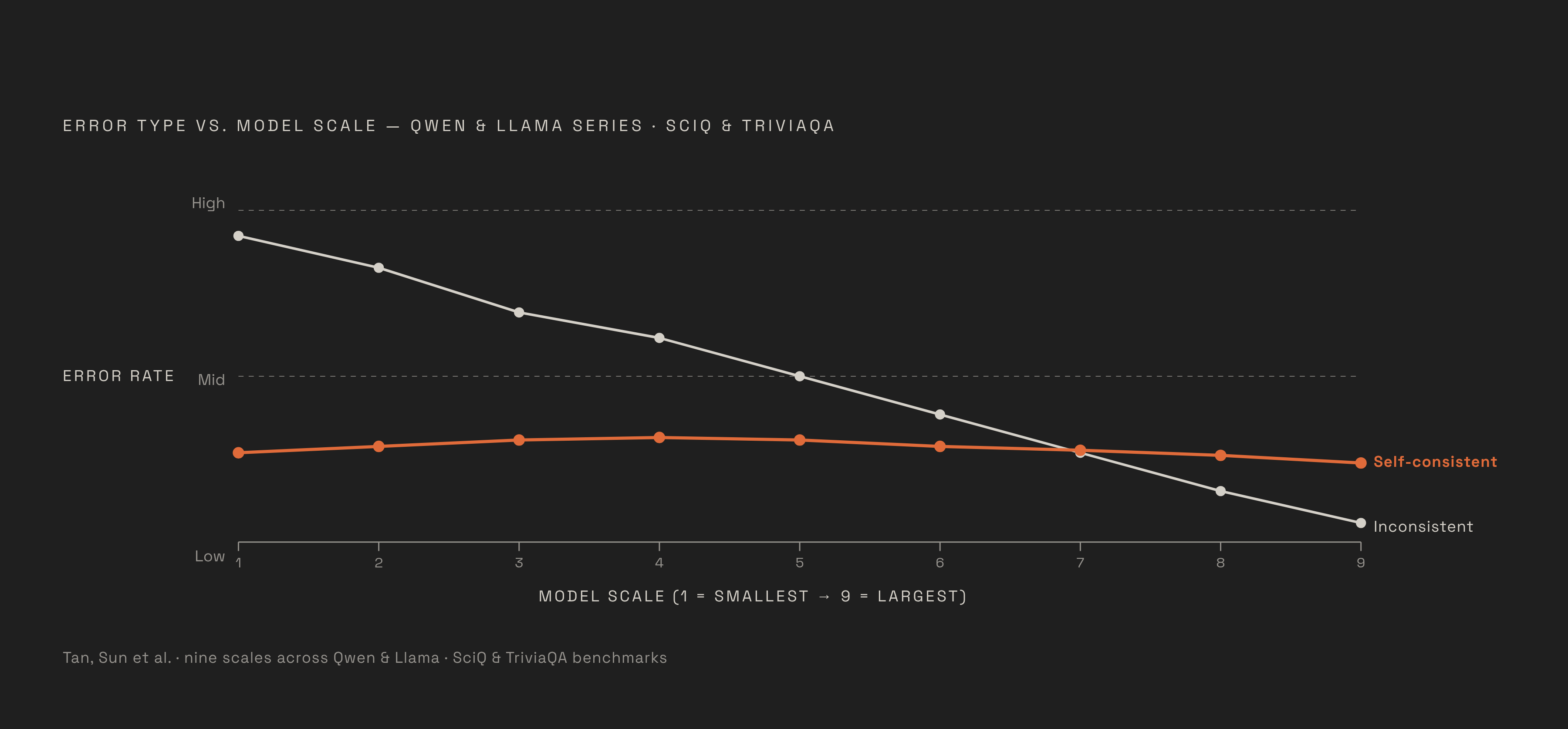
Tan, Sun et al.’s Too Consistent to Detect defines a “self-consistent error” as semantically equivalent incorrect responses produced across multiple stochastic samples for the same question. Majority voting selects the wrong answer with maximum agreement. A detector relying only on disagreement has no signal to distinguish that result from a stable correct answer.
The study tested nine model scales in the Qwen and Llama series on SciQ and TriviaQA. As model scale grew, inconsistent errors fell, but self-consistent errors stayed at the same level or rose slightly. Scaling did not remove this failure mode. The distinction is consequential because an improvement in aggregate accuracy can coexist with a persistent class of confidently repeated mistakes.
The same study evaluated probability-based, prompt-based, supervised probe-based, and consistency-based detectors. All four categories showed substantial performance drops on self-consistent errors, with consistency-based methods deteriorating the most. Their AUROC fell to or below 0.5 on self-consistent error subsets. Even supervised probes using internal hidden states suffered significant declines, indicating that access to the producing model’s internal representations did not reliably resolve the problem.
This is the central limitation. The same process that rewards correct answers when they repeat also rewards wrong answers when they repeat. More samples cannot show disagreement when the model keeps making semantically equivalent errors. When agreement becomes a confidence score, the score can therefore be strongest for an answer the system most needs to challenge.
What cross-model probing adds and what it costs
Tan et al. found that self-consistent errors tend to be model-specific and rarely overlap across different LLM families. That creates a route to independent evidence. Their cross-model probe feeds the original response into an external verifier LLM, extracts the verifier’s hidden states, and trains a dedicated probe on those states. It then combines that score with the original model’s probe score. Tests across three LLM families showed that the probe was much better at finding self-consistent errors.
SAC³ and CONFACTCHECK also use cross-model comparisons, although their checks differ from a trained hidden-state probe. A second model may expose an error that is invisible within the first, making cross-model verification a mitigation.
That improvement requires a different operating model. At least two LLMs must be coordinated, versioned access maintained, and their evidence integrated through a scoring layer. Cost now spans two inference pipelines, while prompt behavior, latency, and failure modes require separate tracking. For the hidden-state approach, the verifier must also provide the internal access the probe requires. This is substantially more infrastructure than repeated calls to a single model.
Why self-consistent errors matter more in some enterprise workflows than others
The operational risk depends on what a confident wrong answer can trigger. In clinical decision support, hallucinations can range from subtle patient-data misinterpretation to fabricated medical information, with consequences including incorrect diagnoses, inappropriate treatment recommendations, and missed critical care. The danger extends beyond the initial response. An error that feeds later clinical decisions can propagate through the workflow.
An early self-consistent error can pass consistency checks and enter subsequent steps without correction, while any later divergence appears far from its source. This pattern is described as “hallucination drift.” It makes the location of an error as important as its frequency, because downstream decisions may depend on an earlier output that appeared stable. In such workflows, treating agreement as approval can actively weaken protection.
How self-consistency fits into a layered reliability stack for production agents
Assign each layer a distinct failure mode. Zhan and Saif’s 2026 comparative study establishes complementary tradeoffs among prompt engineering, retrieval-augmented generation, and self-consistency decoding. Prompt-based methods are lightweight but less robust, while retrieval improves factual grounding at the cost of latency. Self-consistency adds an uncertainty signal. These roles support a layered design rather than a choice of one technique to replace the others.
Within that design, a low-consistency score should flag an output for further verification. Divergence identifies uncertainty. Retrieval grounding addresses cases where the correct answer is available in a knowledge base, reducing reliance on the parametric memory in which a repeated error may reside. Cross-model verification can catch self-consistent errors that single-model sampling and retrieval miss. Because that verification is expensive, it should be reserved for the highest-stakes outputs, with human review gates providing another route for escalation.
Logical consistency checking looks at how an output relates to the model’s stated judgments, adding another signal without the overhead of generating more text. Using explicit confidence elicitation along with sample-based consistency can also make uncertainty calibration better than using either one alone. These signals still require verification around them. For critical decision-making tasks, the production-readiness target in this framework is a hallucination rate of less than 1%, with fully auditable decision trails for all agent actions.
What an AI operations audit establishes before choosing a mitigation stack
An AI operations audit must set the workflow baseline before the architecture is chosen. Otherwise, improvement has no defensible point of comparison. Readiness includes hallucination-rate targets, observability infrastructure, and governance requirements, but the baseline must also describe the process the agent will change. A claim that AI saves time is insufficient without business and risk measures against which the AI-assisted workflow can be assessed.
For hallucination mitigation, the audit should identify where a confidently wrong output would have serious consequences. It should also distinguish outputs grounded in retrievable knowledge from those dependent on parametric memory, where cross-model verification may be required. The latency budget belongs at the workflow-step level. These findings guide the use of retrieval to resolve the relevant uncertainty, the justification for a second model, and the placement of necessary human review. They also make the cost of each layer explicit before that cost becomes a reason to bypass checking.
The alternative is to discover coverage gaps after deployment. The fintech transaction-reconciliation case illustrates that sequence, with high test accuracy followed by production failure and costly retroactive remediation. Testing still has value, but test accuracy alone does not show that a system is ready for the workflow. An audit connects the expected failure modes to the consequences and constraints of the actual process.
How to measure whether the mitigation stack is actually working
Measurements should show how much self-consistency helps, rather than give the whole stack credit for every gain. Teams should track how often low-consistency flags point to outputs that retrieval checks, cross-model probes, or human review later reject. That measures the precision of the uncertainty signal. Self-consistent errors must also be tracked apart from inconsistent errors, because the overall hallucination rate can fall while the number of stable wrong answers stays the same. The findings from Tan et al. make that separation essential to evaluating the blind spot.
Evaluation must also reflect the production domain and prompt structure. Stanford’s 2026 AI Index found that frontier-model hallucination rates changed widely with the conditions under which models were tested. The measurement system should link technical error rates to the problems they cause downstream, including reconciliation errors, flagged legal filings, and escalated clinical decisions. Comparing those outcomes with the predeployment baseline shows how much the stack helps in practice, beyond what detector scores show.
ISACA’s 2025 retrospective states, “Hallucinations are not quirks. They are safety risks. Design every high-impact AI system with the assumption it will sometimes be confidently wrong.” That assumption requires continuous operational measurement. Agreement alone is not the success criterion.
Notes
- Decoding Memories: An Efficient Pipeline for Self-Consistency Hallucination Detection
Provided the Decoding Memory Pipeline details including the selective inference and annealed decoding mechanisms and the reported speedup figures on TriviaQA, NQ-Open, SQuAD, and HaluEval.
- Too Consistent to Detect: A Study of Self-Consistent Errors in LLMs Hexiang Tan
Provided the core findings on self-consistent errors, including the nine-model scale study across Qwen and Llama series, the AUROC results for consistency-based detectors, and the cross-model probe approach.
- Consistency Is the Key: Detecting Hallucinations in LLM Generated Text By Checking Inconsistencies About Key Facts
Provided the basis for the CONFACTCHECK variant description, including its approach of identifying key named entities, generating factual probe questions, and comparing detection accuracy against sample-comparison baselines.
- Benchmarking Hallucination Mitigation Techniques in Large Language Models: A Comparative Study
Provided the comparative tradeoffs among prompt engineering, retrieval-augmented generation, and self-consistency decoding cited in the layered reliability stack section.
- A Comprehensive Survey of Hallucination in Large Language Models: Causes, Detection, and Mitigation
Provided background on hallucination types, distinguishing intrinsic hallucinations that contradict input context from extrinsic hallucinations that introduce unsupported information.
- Combining Confidence Elicitation and Sample-based Methods for Uncertainty Quantification in Misinformation Mitigation
Supported the claim that combining explicit confidence elicitation with sample-based consistency improves uncertainty calibration compared to using either method alone.
- Hallucination Detection and Mitigation in Large Language Models
Provided context on hallucination detection methods and the layered mitigation approaches including logical consistency checking as an additional signal.
- Logical Consistency as a Bridge: Improving LLM Hallucination Detection via Label Constraint Modeling between Responses and Self-Judgments
Provided the basis for the logical consistency checking approach that examines how an output relates to the model's stated judgments as an additional signal.
Every new piece from Hallucination Report, as it's published.
FollowGuide
- AI Hallucination Examples: Real Cases and the Checks That Catch ThemDocumented AI hallucination examples from courts, customer service, government, publishing and healthcare: what the AI produced, what was true, and the check that would have caught it.
- What Is AI Hallucination? Meaning, Causes, Types and How to Catch ItWhat AI hallucination means, why language models produce it, the six kinds to watch for, and the checks that catch a hallucinated answer before anyone relies on it.