Hallucination Taxonomy in AI-Generated Legal Filings
Four types of AI legal hallucinations require different verification methods to catch.
AI-generated legal filings can fail through invented cases, misstated holdings, or fabricated quotations from real opinions. Those errors require different checks, and an emerging fourth category concerns whether an authority governs the claim at all. A hallucination taxonomy is therefore the prerequisite for meaningful verification and risk management.
Why legal hallucinations are a classification problem, not a reliability problem
Mata v. Avianca made the risk of fabricated legal authority well known to lawyers in June 2023. The case appeared to present a straightforward problem of invention, but the defective material included both wholly fictitious decisions and fabricated language attributed to a real case. The distinction changes what verification must accomplish. A search for an existing decision can expose an invented citation while leaving a false quotation untouched.
The common description that AI sometimes makes things up obscures this difference. Reliability describes the desired result. A nonexistent case, a misrepresented holding, and an invented passage fail at different points in the relationship between a filing and its authorities. Treating them as one defect encourages a single check where several are needed.
Type one: citations to cases that do not exist
A fictitious citation has no underlying decision against which the filing can be tested. Its parties, court, case number, and purported holding may all be invented. Either the cited case exists or it does not, making this the most readily defined category and the natural starting point for automated detection.
In Mata, Steven Schwartz used ChatGPT and then submitted six defective decisions, including five wholly fictitious cases and one real case with made-up quoted language. The court imposed a $5,000 sanction against Schwartz, co-counsel, and their firm. Later filings show the problem extending beyond that foundational incident. Coomer v. Lindell, in July 2025, involved a brief with nearly 30 defective citations, including nonexistent cases, and fines against each attorney representing Mike Lindell.
The direct check is whether the decision exists at the cited reporter and page. That check must cover every citation. When there are many filings to check, even a simple lookup takes a lot of work, especially where access to databases is limited. Even a defect that is easy to define can be hard to control, because someone still has to run the search and find out why it returned no result.
Type two: citations to real cases that misrepresent what those cases held
The citation locates an actual opinion, but the filing attributes an inaccurate or overstated proposition to it, or invokes it for a claim the decision contradicts. The source exists, but the asserted support does not. Verification must therefore move from locating a document to interpreting what it decided.
This category exposes the limits of retrieval as a safeguard. Finding relevant text does not establish that a model has described its legal effect correctly. A genuine quotation can also fail to support the proposition attached to it, even when every quoted word is accurate.
Maksym Taranukhin and Vered Shwartz argue that legal hallucination should be evaluated through legal warrant rather than factual accuracy or citation existence alone. Their federal appeal-deadline example contrasts FRAP Rule 4(a)(1)(A) with Rule 4(a)(1)(B), illustrating why finding real authority cannot settle whether an answer is legally supported. The distinction also marks this category’s boundary. Misdescribing what an authority provides is a type-two error, while accurately describing an authority that does not govern the circumstances is the separate warrant failure examined below.
Type three: fabricated quotes attributed to real cases
A fabricated quotation borrows credibility from an authentic citation. The citation identifies actual parties, a court, and a decision, but the words attributed to the opinion never appeared there. Mata included this form of defect as well as fictitious cases. In a drafting workflow, confirming the underlying decision can create misplaced confidence that the quoted passage has also been checked.
The verification target is now the exact language. A practitioner must retrieve the opinion and locate the passage, rather than rely on a headnote, syllabus, or general understanding of the holding. This can require reading the entire opinion. Compared with an existence lookup or a holding review, quotation verification demands a more granular comparison between the filing and the source, which is easily omitted when quotations are treated as settled once a citation resolves.
A fourth, emerging type: warrant failure that standard taxonomies miss
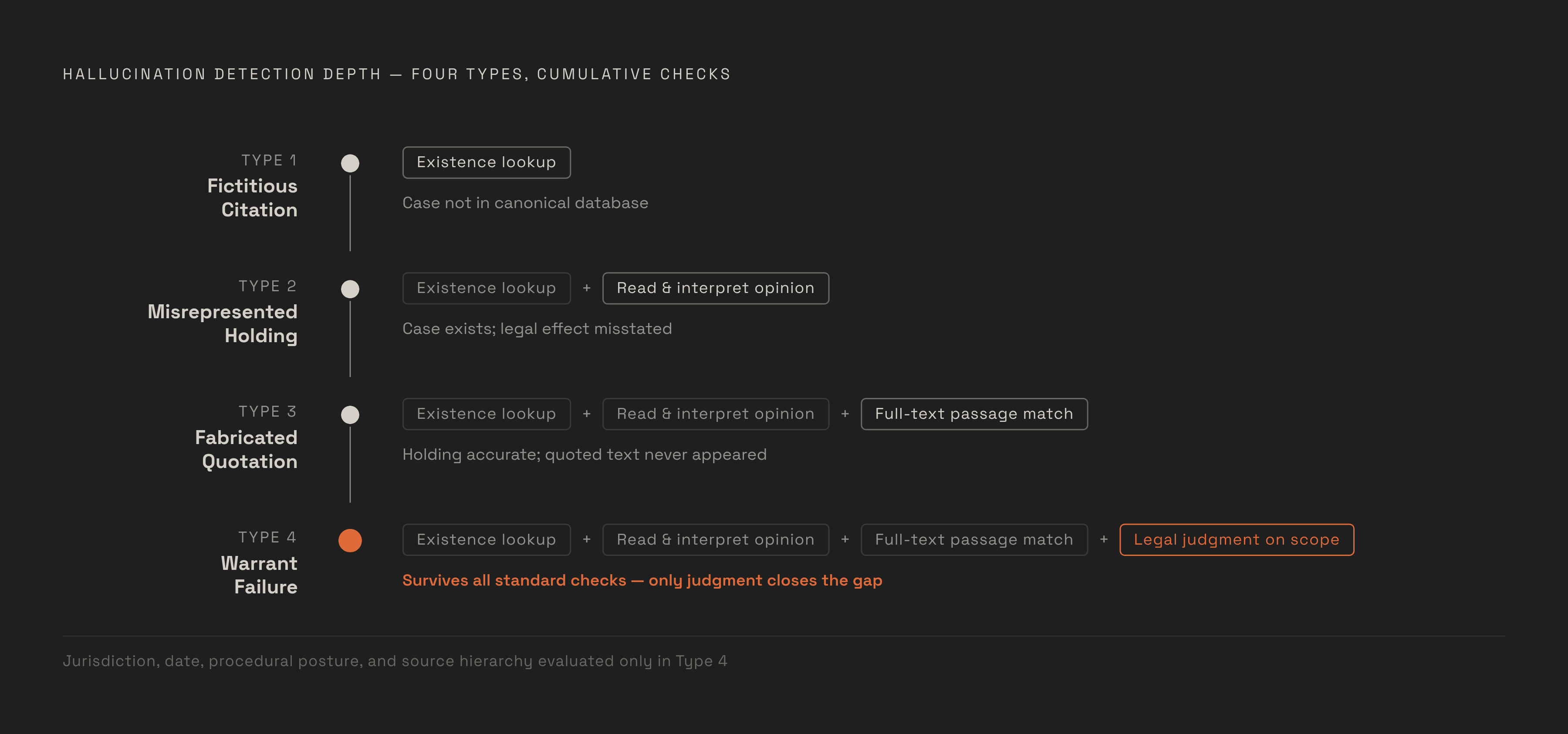
A further failure can survive all three checks. The authority exists, its holding is accurately described, and its quoted language is authentic, yet it does not warrant the claim for the jurisdiction or circumstances at issue. Accuracy is necessary but insufficient in this category. A correctly described decision from the wrong jurisdiction, or a dissent presented with the status of a majority opinion, can leave the legal proposition unsupported.
Taranukhin and Shwartz’s CLAW framework tests the claim-authority relationship through five requirements. The authority must exist, apply to the relevant jurisdiction, be current for the date of analysis, have the legal status represented, and support the asserted proposition. Their example uses Rule 4(a)(1)(A) versus Rule 4(a)(1)(B). Surface checks can pass while the selected provision fails to warrant the appeal-deadline answer under the facts presented.
The difference from type two is precise. The system need not misstate the rule to apply the wrong rule. Verification must confirm textual accuracy and account for jurisdictional scope, procedural posture, and source hierarchy. A checklist limited to the three familiar categories consequently leaves a gap that requires legal judgment to close.
Why hallucination rates are not falling even as models improve
Better models would reduce the urgency of these distinctions if improvement reliably removed the errors. Patty Liu, Dominik Stammbach, and Peter Henderson tested eight generations of ChatGPT on 92 legal drafting prompts and found that hallucination rates were no longer consistently declining. GPT-5.1 produced hallucinated citations at a statistically significantly higher rate than the best mid-2024 GPT-4o release.
The same study found that the number of real-world filings with hallucinated citations was growing steadily from year to year. Newer models also generated more citations per document from a broader, less canonical set of cases that were individually harder to verify. Even if the error rate per document fell, cheaper drafting could lead to so much more drafting that the total number of defective filings would stay the same or rise.
Souvick Das, Sallam Abualhaija, and Domenico Bianculli’s August 2026 study examined eight legal retrieval-augmented generation systems and found pervasive hallucination despite retrieval grounding. Results varied widely, with errors in nearly half of the responses in the worst case. The systems failed especially often on questions with a false premise. These findings undermine the assumption that retrieval or a newer model generation makes verification unnecessary.
How detection difficulty maps onto the taxonomy
The taxonomy turns verification into a set of distinct tasks. Type one calls for an existence lookup in a canonical legal database at the cited reporter, volume, and page. Type two calls for reading the opinion and comparing its holding with the proposition attributed to it. The practitioner’s task changes from identification to interpretation, so success at the first check provides no assurance of success at the second.
Type three requires full-text retrieval and comparison of the exact quoted passage with the opinion. When a search finds no match, a person must confirm that the passage is absent before calling it fabricated. Type four extends the review beyond the words of the authority to its applicability across jurisdiction, date, forum, procedural posture, and source hierarchy.
Liu and colleagues benchmarked five AI-based verification systems and found strong recall from GPT-5 in an agentic framework, but difficulty across models with subtle error categories. Agentic verification is also resource-intensive. GPT-5 averaged 15.3 steps per excerpt, making improved detection a workload consideration with its own review costs. The benchmark supports using automated tools to help, while still checking beyond what they find.
Systems without Westlaw or Lexis access face limits on the full-text verification that holdings and quotations require. The same constraint disadvantages pro se litigants and under-resourced practitioners. Liu and colleagues call for automated tools, public access to legal data, and AI literacy aimed at unrepresented filers, but each of these changes requires knowing what kind of error to look for.
What courts and rules currently require — and where the gaps are
ABA Formal Opinion 512, issued July 29, 2024, states that lawyers using generative AI retain their duties of competence, candor, and confidentiality. The verification obligation remains with the lawyer. Federal courts have also applied existing professional-responsibility requirements and Rule 11 of the Federal Rules of Civil Procedure to hallucination incidents. These obligations do not transfer to a tool simply because it supplied the defective authority.
Whiting v. City of Athens produced a forceful federal appellate response in March 2026. Two dozen-plus fake citations on appeal resulted in a $15,000-per-attorney punitive sanction, full appellate attorney fees, double costs, and a disciplinary referral to the chief judge. Yet no uniform verification standard followed, and the duties themselves do not prescribe a separate method for each hallucination category.
A requirement to verify does not, by itself, explain when a database lookup is sufficient or when the full opinion and its applicability must be examined. The taxonomy draws that missing distinction while leaving the governing obligations in place.
Designing legal AI workflows that account for all three types
To put those obligations into practice, legal AI workflows should have a separate check for each type of error. Automated existence checks against canonical databases should flag non-results for human review. Holding verification should check each cited decision against the claim made about it, and any AI used to make that judgment should follow a structured warrant-checking protocol. Quote verification should get the full text and have a person find every quoted passage, because spot-checking leaves some quotations unchecked.
Warrant verification should then assess every consequential claim through jurisdiction, date, source status, and support, using CLAW as a reproducible template. These checks have different review demands. Human-review thresholds should vary by drafting task to reflect the severity of the error type and the consequences of the output. A tolerance suitable for low-stakes drafting is not suitable for material that goes directly into a court filing.
Production-ready legal agents also require observability across inputs, retrieval steps, reasoning chains, and outputs so that a citation’s path into a filing is auditable. Thomson Reuters’ CoCounsel added autonomous document review and deep research in August 2025 and became a next-generation fully agentic platform in August 2026. That shift makes verification more important as agents move from finding citations to carrying out research tasks with several steps. More authoritative-looking output does not establish that its holdings and quotations are sound.
Before deployment, an AI Operations Audit should establish hallucination rates by type, map them to filing risk, and set human-review thresholds. It should also account for database access and the resource cost of agentic verification. Those measures make how well verification works and how much review it takes part of judging the deployment’s value, alongside how fast it drafts. Taxonomy is the diagnostic tool, workflow is the treatment, and the audit is the readiness check that distinguishes a value-producing legal AI deployment from a source of liability.
Notes
- Who Checks the Citations? Benchmarking Legal Hallucination Detection
Provided benchmarking data on AI-based verification systems, the GPT-5 agentic framework performance, and sanction figures from Mata and Whiting cases.
- AI Hallucination Legal Cases: A Sanctions Tracker (2026) — GC AI
Provided the sanctions tracker details for cases including Coomer v. Lindell and the ABA Formal Opinion 512 reference.
- How Much Do Legal RAG Systems Still Hallucinate?
Supplied findings on eight legal RAG systems showing pervasive hallucination despite retrieval grounding, including failure rates on false-premise questions.
- Legal LLM Hallucination Should Be Evaluated as Failure of Legal Warrant
Introduced the CLAW framework and the argument that legal hallucination should be evaluated as failure of legal warrant, including the FRAP Rule 4(a)(1)(A) versus 4(a)(1)(B) example.
Every new piece from Hallucination Report, as it's published.
FollowGuide
- AI Hallucination Examples: Real Cases and the Checks That Catch ThemDocumented AI hallucination examples from courts, customer service, government, publishing and healthcare: what the AI produced, what was true, and the check that would have caught it.
- What Is AI Hallucination? Meaning, Causes, Types and How to Catch ItWhat AI hallucination means, why language models produce it, the six kinds to watch for, and the checks that catch a hallucinated answer before anyone relies on it.