LLM-as-Judge Reliability for Factual Output Evaluation
Biased LLM judges fail silently on factual tasks—design and testing matter more than model choice.

LLM-as-judge makes factual output evaluation scalable, but its reliability is conditional. A useful verdict depends on the rubric, the evidence available to the judge, and the controls around its decisions. Production evaluation therefore requires more than a capable model. It requires a design that detects bias, calibrates judgments against human labels, and routes unresolved factual questions to evidence retrieval or human review.
Why LLM-as-judge became the default evaluation layer for factual outputs
LLM judging addresses a practical constraint in evaluating model outputs. Collecting ground-truth labels at production scale can be expensive or infeasible, particularly for factual agent outputs. Most use cases fit one of three evaluation patterns: pairwise comparison, single-output scoring with a reference answer, and single-output scoring without one. Each fits a different production context. Pairwise comparison supports choosing between responses, while reference-based scoring anchors an assessment to an expected answer and reference-free scoring operates without that anchor.
Yamauchi et al.’s GEM 2026 study found that LLM judges can agree well with human preferences when they are designed in the right way. But agreement in those settings does not show that the judge can be trusted on every task.
The structural distinction that makes factual evaluation harder than subjective evaluation
Badshah et al.’s COLM 2026 paper distinguishes subjective evaluation, where no single correct answer exists, from objective factual evaluation. Subjective scoring can admit approximate agreement about helpfulness or quality. Factual judging requires a correct or incorrect determination. Removing the reference answer also removes the external anchor for that determination, leaving the judge to assess whether it has enough knowledge to decide.
Reference-free factual judging has two structural failure paths. First, the judge may rely on parametric knowledge bounded by its training data, leaving recent events, rare entities, and specialized domains outside its knowledge. Second, even when relevant knowledge is available, hallucinations can produce confident but incorrect verdicts. Both failures can remain silent. The verdict gives no indication that the assessment itself is unreliable.
That silence distinguishes an uncertain evaluation from a visibly incomplete one. An incorrect verdict can propagate into downstream decisions without triggering review because it appears to be a completed assessment. Agentic workflows compound the problem when a judge’s output gates subsequent actions. The evaluation layer then becomes part of the decision path. Its reliability must cover factual correctness, rather than only agreement with judgments about how an answer reads.
The four bias types that systematically distort LLM judge verdicts
Bo Yang and colleagues’ FairJudge, published in February 2026, identified three compounding limitations in automated judging. Criteria mismatch applies chat-quality rubrics to domain-specific tasks, while non-semantic bias lets position, length, formatting, or provenance influence the result. Score-Comparison Inconsistency produces circular preferences in which A beats B, B beats C, and C beats A. These problems do not operate in isolation. A mismatched rubric can reward surface cues while producing scores that conflict with pairwise judgments.
With position bias, where a candidate is placed affects the verdict. Swapping candidates can reveal repetition instability when verdicts change, but verdicts that stay the same regardless of quality give no assurance that the judge is sound. The choice pair framework distinguishes position-consistent, primacy-preferred, and recency-preferred signatures. The comparison must track which candidate is which across the swap. Otherwise, a preference for the first or last slot can be mistaken for a preference for the answer itself, with the effect varying across judges and tasks.
Verbosity bias rewards length, allowing a longer answer to receive a higher score even when a shorter answer is more accurate, so fluent elaboration becomes a confounder in the assessment. Self-preference bias instead concerns the relationship between generator and judge, with a judge inflating win rates for outputs from its own model family. EMNLP 2025 research distinguishes genuine quality preference from the harmful failure to penalize the judge’s own errors. Favoring a family is not evidence that its answers are better.
Self-enhancement bias is the narrower case in which the same model both generates and judges an output, further inflating scores. The shared role compromises the independence of the assessment. Average agreement rates and benchmark accuracy describe overall performance, leaving the distribution of failures across these four mechanisms unexamined. Borderline cases can still be judged poorly even when the overall score looks good. Detecting the bias requires examining what changes a verdict.
What the RAND reliability harness and JudgeBiasBench found about production-grade judges
Sunishchal Dev, Morgan Sandler, and colleagues at the RAND Corporation released the Judge Reliability Harness in March 2026. The open-source library uses consistency and discriminative tests to stress-test judges. The team evaluated four judges across safety, persuasion, misuse, and agentic benchmarks and found that none was uniformly reliable. Ordinary variation was enough to disrupt consistency. Formatting changes, paraphrasing, and shifts in verbosity changed judgments without requiring adversarial perturbations.
Hongli Zhou and colleagues’ JudgeBiasBench found that frontier models exceeded a majority error rate on advanced bias tests. That finding concerns performance under bias stress, a distinct measure from ordinary LLM-human agreement. The two measures answer different questions. Human-level agreement on one benchmark cannot establish resistance to bias on another, so the bias-test error rate cannot be explained away by a comparison with how often humans agree.
Schroeder and Wood-Doughty at Northwestern introduced a framework that uses McDonald’s omega to measure how reliable a judge is. Their findings separate repeatability from dependable assessment. Deterministic settings can improve consistency, but a single sample from the model’s probability distribution can still be misleading. Using more than one sample reveals risks that single-shot evaluation leaves hidden. Taken together, these studies show why standard judge evaluation is insufficient when it reports only average accuracy rather than performance on the borderline outputs a production model actually generates.
How design choices — not just model selection — determine whether a judge holds up
Practitioners can address several of these failures through evaluation design. Yamauchi et al. found that evaluation criteria are critical to reliability, with omitted reference answers or score descriptions significantly degrading human alignment and consistency. How the prompt is structured, what the rubric covers, and how samples are drawn shape the signal as directly as the model that produces it.
The same study found that non-deterministic sampling improved alignment with human preferences over deterministic evaluation. This does not contradict the finding that deterministic settings can improve consistency. The objectives are different. Repeating a verdict more consistently does not establish that it is closer to human judgment, while sampling can reveal variation hidden by a fixed setting.
Calibration establishes whether a judge’s score has a measurable relationship to the intended quality standard. The calibration loop samples production traces and asks two to three humans to label them using the same rubric as the judge. Cohen’s kappa measures inter-annotator agreement for two annotators, while Krippendorff’s alpha serves three or more. Judge-to-human agreement is then measured against that baseline. Human disagreement becomes part of the assessment rather than an unexamined assumption about ground truth.
Bias mitigation gives that calibrated rubric more specific controls. Explicit length penalties or token-count normalization help counter verbosity bias, and using a judge from a different model family lowers the risk of self-preference and self-enhancement. The same model should never be both generator and judge. Two to four annotated few-shot examples offer a low-cost way to calibrate the prompt to the intended quality standard. These controls improve how the judge applies its knowledge, but they cannot supply factual knowledge it lacks.
The uncertainty-routing approach for factual evaluation where reference-free judging is unavoidable
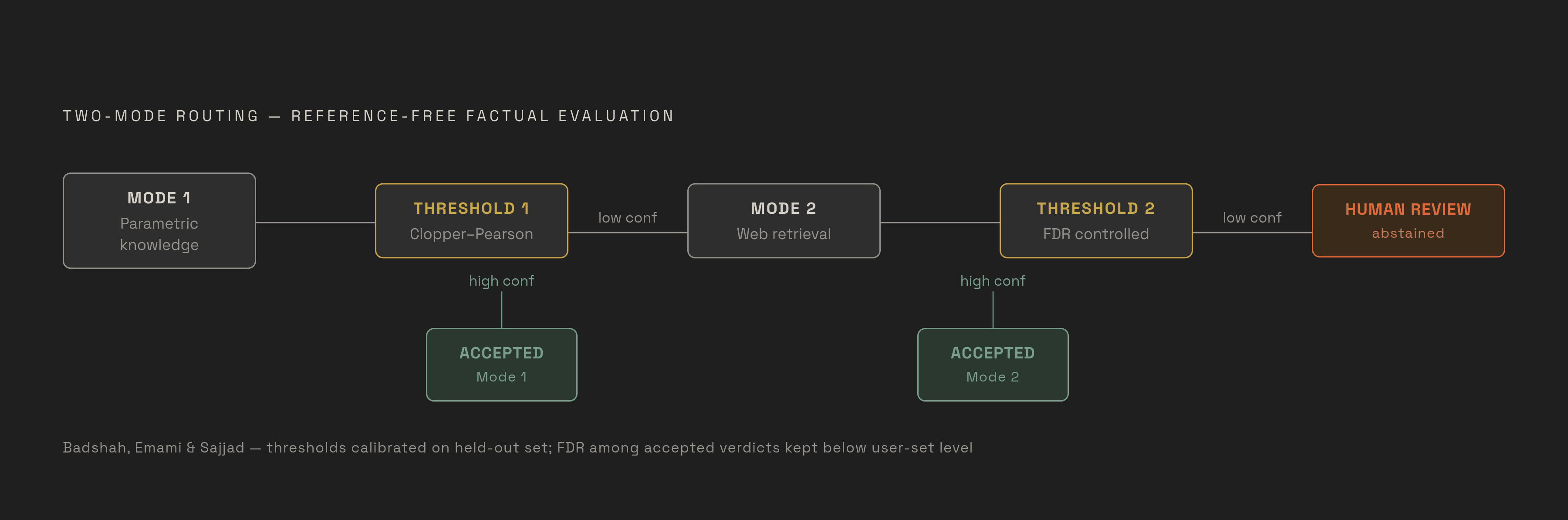
Badshah, Emami, and Sajjad propose a two-mode framework for the cases that rubric improvements cannot resolve. Mode 1 uses the judge’s parametric knowledge to assess an output. If confidence falls below a calibrated threshold, the instance moves to Mode 2, where the judge retrieves web evidence and re-evaluates it. Persistent uncertainty triggers abstention and human review. The judge is not required to turn every input into an accepted factual verdict.
This routing structure gives retrieval a defined role. It supplies evidence when the first mode cannot support a sufficiently confident assessment, rather than treating retrieval alone as proof of correctness. The second threshold then governs whether the evidence-assisted verdict is accepted. An unresolved case remains visible because the framework can stop short of judgment.
The thresholds are calibrated on a held-out set using finite-sample Clopper–Pearson intervals. With this calibration, there is a high probability that the false discovery rate among accepted verdicts stays below the level the user sets. The guarantee extends to the two-threshold routing without additional assumptions. The guarantee applies only to accepted verdicts. Coverage and error control are therefore separate properties of the system.
The study found that the framework kept to its target error rate across open-domain QA benchmarks and judges of different scales, with substantially higher coverage than single-mode baselines. The operational payoff is the abstain-and-flag path. It keeps unresolved evaluations in view without forcing them into scores that look final, and it points humans to cases that need review. Unlike rubric refinement or sampling changes, this approach addresses the judge’s lack of sufficient knowledge to evaluate a factual claim.
What a production-ready evaluation stack looks like when these conditions are applied together
Metric-based evaluation, including exact match and retrieval precision, handles deterministic output components. LLM judging handles semantic dimensions such as faithfulness, relevance, instruction-following, and tone through use-case-specific rubrics calibrated against human labels. Neither method replaces the other. Human review covers cases that automated measures and semantic judgment cannot assess reliably.
For model or prompt comparisons, pairwise evaluation with alternating candidate order addresses exposure to position bias. For unavoidable reference-free factual judgments, uncertainty routing provides the retrieval and abstention path. Human review then covers the small share of samples flagged by the judge or the uncertainty threshold. These controls serve different purposes. Alternating order tests how presentation affects the verdict, while calibrated thresholds set the bar for whether a factual verdict has enough support to be accepted.
Two deployment mistakes undermine this division of work. A judge introduced without human calibration produces a score whose relationship to the intended standard has not been established. A single rubric reused across multiple use cases creates rubric drift that degrades reliability. Both errors detach the evaluation from the task. A production signal depends on the actual outputs being assessed and the criteria appropriate to them.
Agentic workflows also require a broader unit of evaluation. DeepEval’s framework documentation describes trajectory-based evaluation as checking the full trace of model decisions, tool calls, and handoffs in order. Single-output scoring does not cover that scope. An agent whose outputs cannot be judged reliably needs continuous human review to scale safely, so evaluation infrastructure is required for production and goes beyond optional reporting.
An AI operations audit checks whether those conditions are in place before a pilot scales. Its scope includes rubric specificity, calibration status, judge-generator family separation, and the human review sampling rate. The audit is a structural check. The organization must bound the judge’s role, establish the meaning of its scores, and provide a review path for the factual decisions it cannot reliably make.
Notes
- Can You Trust LLM Judgments? Reliability of LLM-as-a-Judge
Provided the McDonald's omega reliability framework from Schroeder and Wood-Doughty at Northwestern, distinguishing repeatability from dependable assessment and the risks of single-shot evaluation.
- Judge, Retrieve, or Abstain: Uncertainty-Guarded LLM Judging with Provable Risk Guarantees
Provided the two-mode uncertainty routing framework (Mode 1 parametric, Mode 2 retrieval-augmented, with abstention) and the Clopper–Pearson calibration guarantees described in the uncertainty-routing section.
- An Empirical Study of LLM-as-a-Judge: How Design Choices Impact Evaluation Reliability - ACL Anthology
Provided findings from the Yamauchi et al. GEM 2026 study on how evaluation criteria, rubric completeness, and sampling strategy affect LLM-human alignment and consistency.
- Are We on the Right Way to Assessing LLM-as-a-Judge?
Provided the Badshah et al. COLM 2026 framework distinguishing subjective from objective factual evaluation and the structural failure paths of reference-free judging.
- Reliability without Validity: A Systematic, Large-Scale Evaluationof LLM-as-a-Judge Models Across Agreement, Consistency, and Bias
Provided findings on reliability without validity, distinguishing agreement and consistency metrics from actual correctness in LLM-as-judge evaluations.
- Judge Reliability Harness
Provided details on the RAND Judge Reliability Harness, including its consistency and discriminative tests and findings that none of four evaluated judges was uniformly reliable.
- Toward Robust LLM-Based Judges: Taxonomic Bias Evaluation and Debiasing Optimization
Provided the taxonomic bias framework from Bo Yang and colleagues (FairJudge), identifying criteria mismatch, non-semantic bias, and Score-Comparison Inconsistency as compounding limitations.
- Bias and Uncertainty in LLM-as-a-Judge Estimation
Provided findings on the JudgeBiasBench result that frontier models exceeded a majority error rate on advanced bias tests, and the distinction between bias-stress performance and ordinary LLM-human agreement.
Every new piece from Hallucination Report, as it's published.
FollowGuide
- AI Hallucination Examples: Real Cases and the Checks That Catch ThemDocumented AI hallucination examples from courts, customer service, government, publishing and healthcare: what the AI produced, what was true, and the check that would have caught it.
- What Is AI Hallucination? Meaning, Causes, Types and How to Catch ItWhat AI hallucination means, why language models produce it, the six kinds to watch for, and the checks that catch a hallucinated answer before anyone relies on it.