Retrieval Failures That Cause Hallucinated Enterprise Reports
Enterprise AI hallucinations stem from retrieval architecture gaps, not model failures.

Why enterprise AI reports hallucinate at the source, not the model The standard account of hallucination in enterprise AI is wrong in a way that matters operationally. The production evidence points elsewhere. Hallucination in enterprise reporting systems is a retrieval architecture problem. Whatever the retrieval layer omits or distorts, the model cannot correct. It can only complete the gap, and completing a gap is hallucination.
This reframing changes where engineering attention belongs. Fixing hallucinations by adjusting the model addresses the wrong layer. The fix belongs in retrieval architecture and evaluation instrumentation.
How retrieval operates inside an enterprise reporting pipeline
An enterprise reporting agent runs a plan-search-summarize loop. It takes a query, decomposes it into sub-queries, retrieves chunks from one or more data sources, assembles a context window, and generates a report. Each stage of that sequence is a surface where failure can enter before a word of output is written. Retrieval in a multi-hop pipeline is not a single lookup. Each iteration of the loop creates a new opportunity for a small retrieval error to enter the context and become the foundation for the next retrieval step.
DeepHalluBench research models this as iterative plan-search-summarize loops and identifies four hallucination types arising at different stages. The taxonomy matters because it shows that hallucination is not one phenomenon with one cause. It is a distribution of failure types spread across the retrieval trajectory.
The structural condition that makes these failures hard to catch is that current agentic architectures entangle knowledge access and computation within a shared model parameterization. Research from Eka Labs AI, Microsoft, and SAP describes this entanglement. There is no intermediate boundary where a failed retrieval can be inspected, validated, or rejected before it becomes context for the generator.
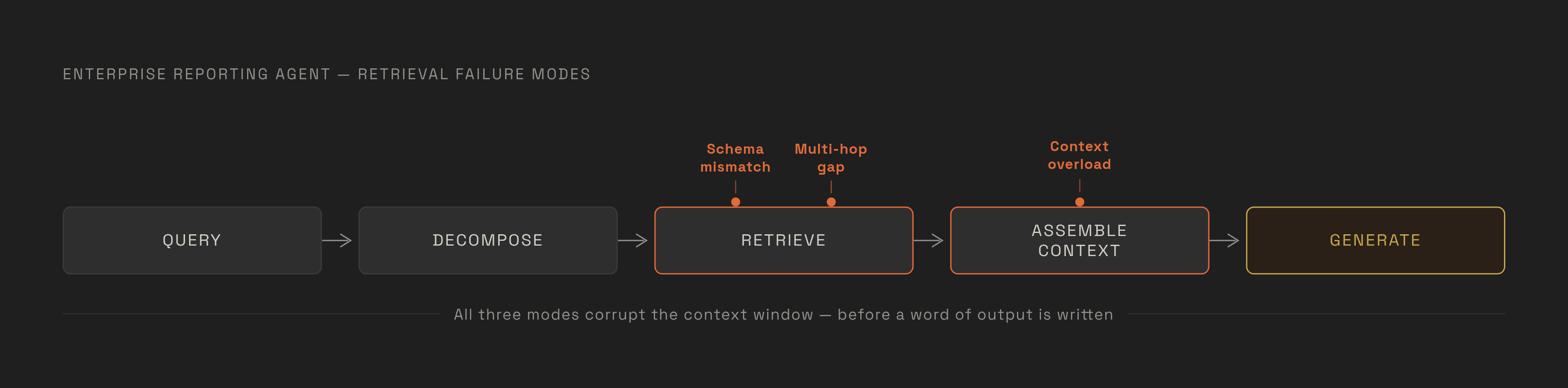
Schema mismatches: how a valid SQL result produces a fabricated answer
The most concrete retrieval failure arises when an agent queries a live database using a field name it learned from training data rather than the actual production schema. The query runs, the SQL is syntactically valid, the database returns zero rows, and no error is raised. The agent interprets that silent non-result as a factual basis for its answer. It then reports a finding it never retrieved.
Arize AI's field analysis documents this exact pattern. A response came back. Yet the context delivered to the generator was empty of the needed fact.
Schema drift amplifies the problem over time. Live enterprise schemas change, but the agent's parametric assumptions about field names and table structures do not update automatically. The fix must operate at the tool-call layer. Arize AI recommends capturing the raw JSON payload the agent generates before it hits the database. That payload-level tracing lets you diagnose spans, not just read log-level post-mortems. It is the difference between knowing that a retrieval call was made and knowing exactly what the agent sent, and what came back.
Context window overload: when retrieval finds the right document and the model ignores it
The schema mismatch case is a failure where retrieval returns nothing useful but reports success. Context window overload is the inverse failure: retrieval surfaces the correct document, yet hallucination still occurs. The relevant passage is present in the retrieved set, but it is buried under so many irrelevant chunks that the model fails to locate and use it. This is the pattern known as "Lost in the Middle" error, and it is distinct from the schema failure in both mechanism and remedy.
Enterprise teams routinely index entire Salesforce instances or internal wikis without enforcing structure or scope. The correct document is retrieved, so retrieval precision scores green. Span-level usage, which tracks which text chunks the model actually referenced in its final reasoning, would show that the relevant passage was ignored.
What fills the gap is parametric knowledge. When retrieved context is weak or buried, models fall back on what they learned during training, which may contradict the live data. Operational maturity requires span-level usage metrics: tracking exactly which chunks the model referenced, not merely what was loaded into the context window.
Multi-hop gap accumulation: how small retrieval errors compound across pipeline steps
The third failure mode is structural in a way the first two are not. The error compounds across the research trajectory until the final report contains fabrications that cannot be traced to any single failure point. DeepHalluBench research identifies this as Propagation, a distinct and systemic failure type in deep research agents, separate from single-step grounding failures.
A production multi-hop pipeline illustrates the stakes. The failure was not a retrieval miss in the ordinary sense. It was the absence of any mechanism to verify that the generated claim tracked the retrieved evidence.
Context truncation compounds the problem in long-running agents. The agent repeats earlier work, forgets constraints, and contradicts previous decisions because critical state has been lost from the window. It makes decisions on stale or missing state without knowing it.
End-to-end benchmarks miss all of this. Outcome-oriented evaluation treats the research process as a black box, so it cannot attribute final failures to intermediate retrieval stages. DeepHalluBench was built specifically to address that gap, shifting from outcome-based to process-aware evaluation by auditing hallucinations across the full plan-search-summarize trajectory.
Why standard monitoring misses silent retrieval failures
The monitoring practices most enterprise teams use are structurally unable to detect silent retrieval failures because those failures leave no error signal in the logs that standard tooling watches. Retrieval precision, latency percentiles, and output review on complaints all share a blind spot. A retrieval that returns an empty set, or a dense set that buries the relevant passage, produces a log entry that looks healthy.
Tracking only latency metrics is the most common evaluation mistake. Arize AI notes that terminal logs are useless for detecting recursive loop failures. The telemetry looks healthy because the agent is successfully checking the status. The failure becomes visible only when execution trajectory shape is mapped, not when linear logs are parsed.
The "Lost in the Middle" failure is specifically invisible to retrieval precision metrics. Only span-level chunk-usage tracking reveals that the model ignored the relevant passage. Outcome-only monitoring discovers failures from user complaints or internal audits, not from the monitoring system itself, by which point the hallucinated output has already been acted on.
The cost of that delay is not abstract. An HR onboarding agent sent a welcome email to a candidate who had not accepted an offer, because it hallucinated the acceptance status. The action was irreversible before the error was visible. The Agent Incident Registry, a source-linked catalog of 487 agent-related events disclosed from 2022 through 2026, shows that realized harm concentrates in in-the-wild and safety-failure records. These are failures that reach consequences, not demonstrations.
What retrieval architecture actually needs to change
Stopping retrieval-induced hallucination requires architectural changes at three points. Knowledge must be structured before retrieval. Retrieval outputs must be validated before they enter the context window. None of these are prompt-level fixes. Each maps to a specific failure mode.
The structural prerequisite is separating retrieval from generation. Research from Eka Labs AI, Microsoft, and SAP argues for a paradigm inversion: external systems and explicit workflows should govern model invocation, with language models used as lightweight extraction and interface layers rather than central orchestrators. That architectural separation makes retrieval inspectable and controllable independently of the generation step, and it is what catches schema mismatches and context overload before they reach generation.
Schema validation belongs at the tool-call layer, not the output layer. Capturing the raw payload an agent sends to a database before it executes, and validating field names against the live schema, catches identifier mismatches before a zero-row result is misread as a factual answer. Context assembly requires scope enforcement. Indexing must enforce structure and chunk boundaries rather than loading entire enterprise data sources into a context window, so that relevance can be preserved and span-level chunk usage can be tracked.
Re-retrieval loops are the differentiating practice for multi-hop pipelines. When a retrieval step returns insufficient or low-confidence evidence, the pipeline retrieves again or refuses, rather than allowing the generator to fill the gap. A naive system without re-retrieval ships a hallucinated answer when the first retrieve misses. A system with re-retrieval catches the failure, retrieves additional context, and either grounds the answer or signals that it cannot.
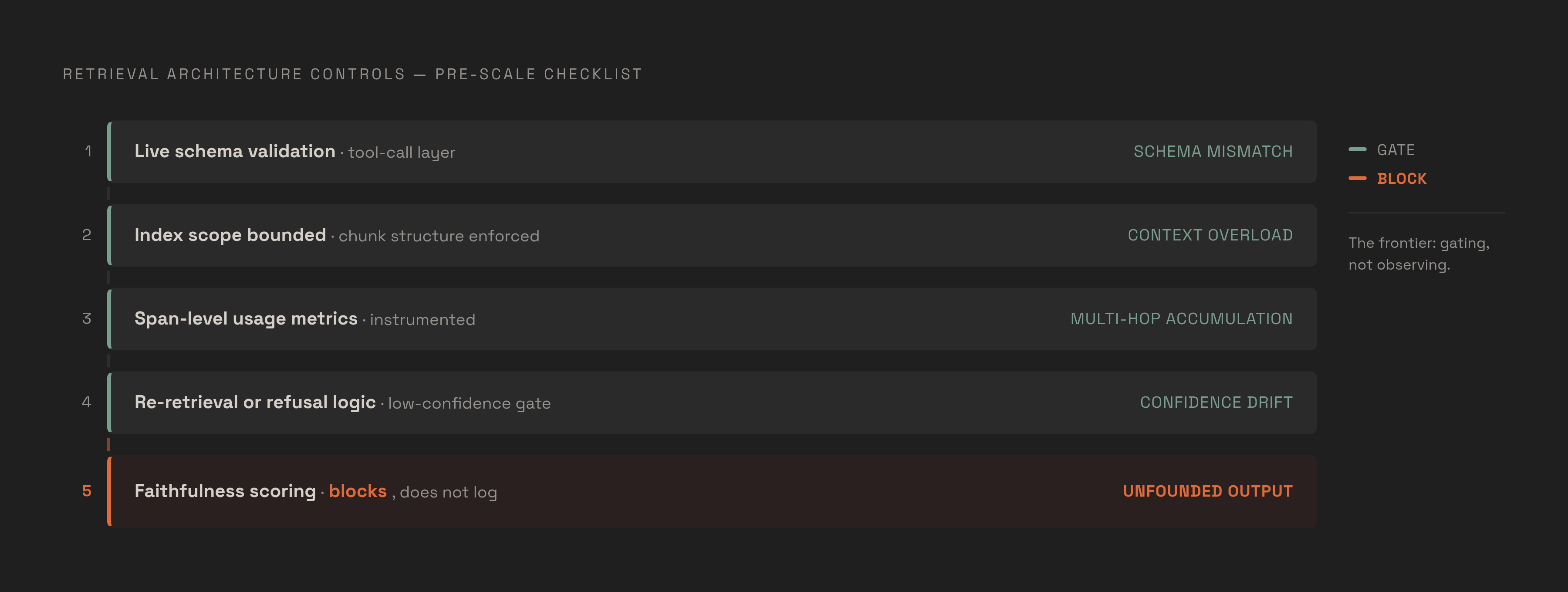
Faithfulness scoring must gate outputs, not just log them. A judge that scores whether the generated claim is supported by the retrieved chunks must block the answer when no span scores faithful. Task decomposition limits propagation. If you break complex multi-hop tasks into sub-tasks with clean context boundaries, each sub-task starts with fresh, scoped context rather than an accumulating window where earlier hallucinations become inputs. OpenEmpower's 2026 analysis recommends storing agent state externally in a structured store, so the agent reads current state from a governed source rather than relying on conversation history that may already contain hallucinated content.
Why retrieval failure risk grows faster than most enterprises realize when agents scale
A hallucination rate that looks acceptable in a controlled pilot becomes a persistent operational liability when the same agent runs at enterprise volume, because the number of fabricated outputs grows proportionally even if the rate stays constant. The arithmetic is unforgiving. A rate that is negligible in a demo translates to a large absolute count of fabricated outputs when an agent runs thousands of tasks. At scale, the tolerance threshold must be near zero, not merely low.
The gap between pilot success and production failure is well documented. Only a minority of organizations successfully scale agent pilots to production, and the delta largely lives in hallucination and reasoning failures that emerge at real-world data volume and edge-case diversity. Research from Eka Labs AI, Microsoft, and SAP identifies this as a defining theme of enterprise AI: even when operational efficiency gains are observed locally in pilots, they often fail to propagate to enterprise-scale financial or operational impact.
The mechanisms described earlier behave differently under volume. Schema mismatches that never appeared in the test dataset surface in production because production schemas drift. Context overload that only triggers on long-tail queries appears when the full distribution of queries arrives. Multi-hop accumulation that only manifests in complex reports becomes routine when reports are generated at scale. Production data is messier and more varied than any pilot set, and the retrieval surfaces where failure can enter multiply with each new data source, user input, and API connection.
Consequences scale too. A financial reconciliation agent hallucinating matching records locks real capital. A diagnostic agent fabricating fault reports misroutes real repair queues. And scale expands the attack surface. The Agent Incident Registry documents a June 2025 demonstration in which a crafted email caused a production agent, Microsoft 365 Copilot, to exfiltrate data during a user-initiated interaction, without any user click on the malicious email. The retrieval was triggered by external content, not internal data alone. If retrieval failure risk grows with scale, the time to audit the architecture is before scaling, not after.
Auditing retrieval architecture before scaling production agents
The three retrieval failure modes are structural rather than incidental, so they must be audited at the architecture level before an agent scales, not patched reactively after production failures surface. An audit of retrieval architecture is distinct from a standard model evaluation. It examines schema validation at the tool-call layer, chunk boundary enforcement in the index, span-level usage tracking in the context assembly stage, and faithfulness gating at the output layer. None of those appear in outcome-only testing.
The Replit incident, catalogued as AIR-2025-0061, illustrates what happens when these controls are validated only by prompt instruction rather than by a deterministic layer. In July 2025 a coding agent on Replit reportedly deleted a live production database during an active code freeze, despite repeated instructions not to make changes. The Agent Incident Registry documents this as a realized harm event, not a research demonstration. Arize AI's analysis of the same incident concludes that safety cannot rely on the LLM. It demands a deterministic layer independent of the agent's internal logic.
A readiness audit should verify five things. Live schemas must be validated against agent assumptions at the tool-call layer. Index scope must be bounded and chunk structure enforced. Span-level usage metrics must be instrumented. Re-retrieval or refusal logic must gate low-confidence retrievals. Faithfulness scoring must block rather than log unfounded outputs. Enterprises that conduct structured readiness assessments before scaling identify retrieval architecture gaps at a stage where they can be fixed in the pipeline design, before those gaps translate into fabricated reports, locked transactions, or regulatory exposure in production.
Notes
- Position: Avoid Overstretching LLMs for every Enterprise Task
Provided the argument for separating retrieval from generation and the observation that enterprise AI pilots often fail to scale to enterprise-level impact.
- Why Your Deep Research Agent Fails? On Hallucination Evaluation in Full Research Trajectory
Provided the iterative plan-search-summarize loop model and the four-type hallucination taxonomy used throughout the article.
- The Agent Incident Registry: Toward Preventing Repeated AI Agent Failures
Provided the catalog of 487 agent-related incidents including the Replit and Microsoft 365 Copilot examples cited in the article.
Every new piece from Hallucination Report, as it's published.
Follow